Bishop Matthias Reeve — The Church
Senior Bishop and Institutional Power-Broker
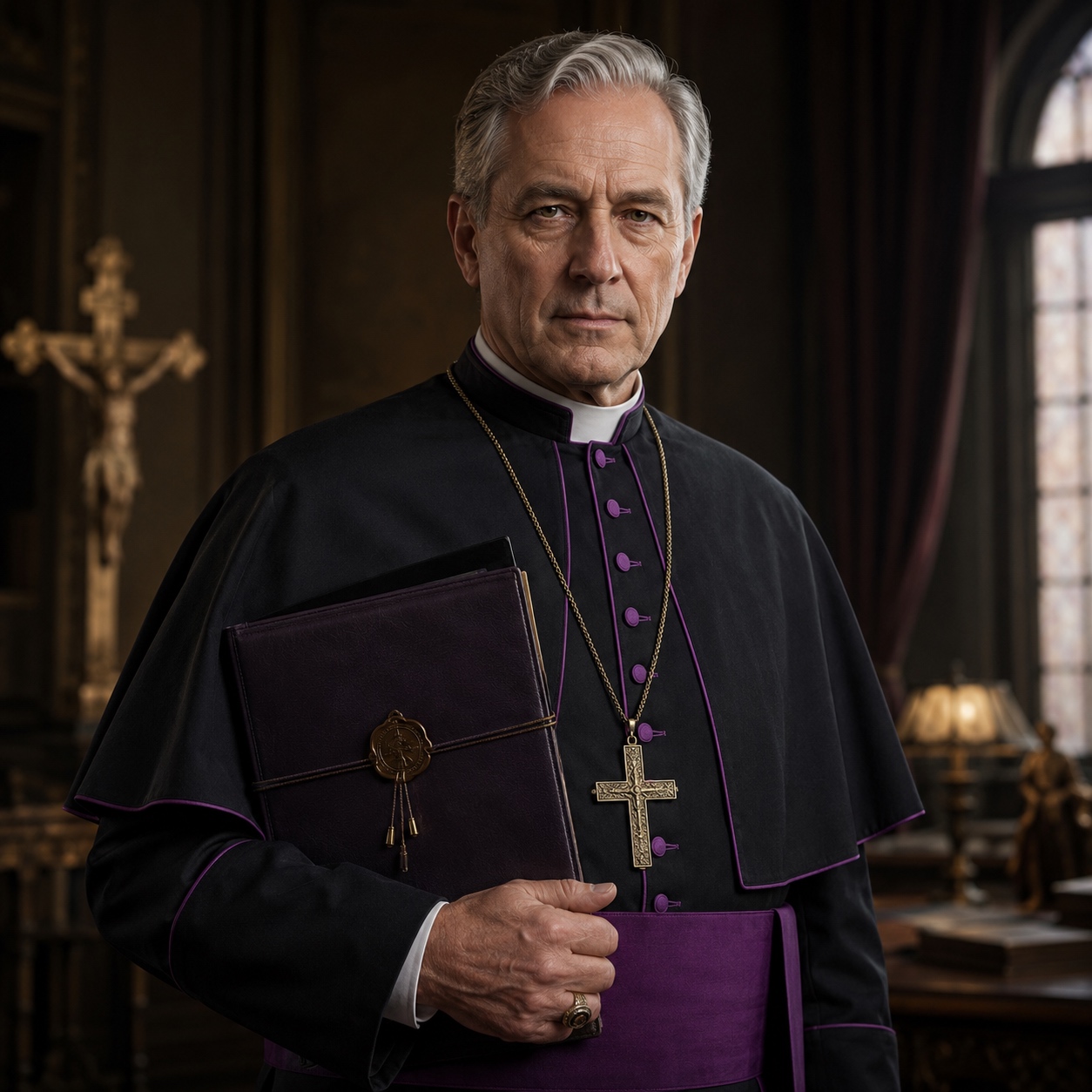
He has been in rooms where history was decided by which man spoke first, and he has learned to be the one who waits. What he says when he finally speaks has always been worth the wait.
Bishop Matthias Reeve
Composure Initiative: 7 Corruption: 1 Sanctity: Fully Effective
Background
Matthias Reeve has been a bishop for eleven years. Before that, twelve years as vicar general for his predecessor's diocese, managing the machinery of a large Catholic administrative unit: personnel, facilities, finance, canonical disputes, media inquiries, and the particular category of problem that lands on a vicar general's desk because no one below that rank knows what to do with it. He learned what to do with it.
He was elevated to bishop at fifty-one, neither young nor old for the honor, on the strength of consistent institutional competence rather than any single dramatic moment. Dramatic moments tend to happen around other men. Reeve reads a situation early enough to redirect it before the drama arrives, a skill he has practiced for twenty-three years now.
His engagement with the Order of Mercy stays formal and institutional. He leaves the field work to people equipped for it and provides instead the administrative and political framework that makes field work possible: authorizations, resource allocations, a diplomatic word with a local ordinary grown suspicious of activity in his diocese, the specific quiet conversation with a cardinal or a nuncio that makes a situation go away.
He has, by now, the particular clarity a senior institutional officer develops about any systemic threat: he knows the Hollow's scope, knows the resources arrayed against it, and holds a clear-eyed view of where the Church's institutional response falls short, including the failures he has personally managed and the ones still unmanaged. He chooses his words on the subject with real care, and chooses his listener even more carefully.
Corruption 1 marks decisions made across twenty-three years that he calls political necessities and a simpler man would call moral compromises. Whether he loses sleep over them depends on the night.
Skills
| Skill | Rating | Skill | Rating |
|---|---|---|---|
| Inquiry | 4 | Deception | 3 |
| Composure | 3 | Negotiation | 3 |
| Theology | 3 | Discernment | 3 |
| Leadership | 4 | Research | 2 |
Faction Passive — Rite of Office (Church Authority, Order of Mercy–adjacent): Bishop Reeve's ecclesiastical authority operates at a higher institutional level than a field operative's Rite of Office. When he invokes his episcopal office in any scene involving Church personnel, Catholic institutional resources, or ecclesiastical administration, the difficulty of relevant checks is reduced by one step. Once per session, he may invoke episcopal authority to override a decision made at a lower clerical level, a vicar general's ruling, a parish priest's refusal, a diocesan administrator's objection, without requiring a separate negotiation scene.
Talents
Network — Rank 3 (Signature Ability): Bishop Reeve has built an institutional network over twenty-three years of Church administration. At Rank 3, once per session he may access any Catholic institutional resource (personnel, records, facilities, finances) at any level up to and including the Vatican's administrative offices, provided he can construct a plausible institutional reason for the request. The GM determines availability, but the network is real and extensive.
Strategic Reserve (Signature Ability): The Bishop does not spend his authority carelessly. Once per session, he may hold an action in a negotiation, political, or institutional scene (announcing his position or deploying a resource) and resolve it at a dramatically optimal moment rather than in turn order. This represents his lifelong habit of knowing when to speak.
Weight of Authority (Commanding Presence Tree, Tier 4, Chapter Six): When Bishop Reeve exerts authority (clerical, institutional, or personally earned) over a resistant NPC, he adds 2 Boon dice to the social check. He has been reading rooms correctly for twenty-three years.
Political Theology (Signature Ability): Bishop Reeve's theological understanding is sophisticated and practically oriented. He can construct or deconstruct a theological argument under field conditions with an Average Intellect + Theology check, producing reasoning that is both technically sound and politically useful. In scenes involving the Church's official position on a specific supernatural event, he may add one Boon die to any check to shape how that position is framed or communicated.
Equipment
- Traditional episcopal dress — black with purple piping and sash, in formal contexts; dark suit with episcopal ring and pectoral cross in professional civilian contexts
- Pectoral cross — worn at all times; heavy silver, not ornamental in the sense of being ceremonial only; it is his
- Episcopal ring — worn on the right hand; visible in any formal context; has been kissed by approximately eleven thousand people over eleven years of episcopal ministry, which he finds touching and occasionally inconvenient
- Official folder — contains current active correspondence, canonical authorization documents, and one sealed letter from a superior authority that he has not yet deployed; the letter has been in the folder for six months
- Encrypted phone — diocese-issue; all external communications with the Order are conducted on a separate device he maintains personally
- Rosary — in his pocket; old, worn, his mother's; he prays it in cars and in waiting rooms and when a situation is worse than he has allowed anyone to see
GM Notes
Reeve opens doors no field operative can open and carries the Church's political weight into scenes that need it. Bring him in when the party needs legitimate institutional access, and lean on him hardest when what they need is something the Church's official position was never going to sanction.
His Network at Rank 3 is the single most powerful resource on any dossier in this book, reaching all the way to the Vatican's administrative offices. Treat it as the option players work toward across a campaign, not the first tool they reach for.
He is complicated rather than villainous. He calls his political decisions governance; a simpler man would call some of them compromises, and a few still carry consequences he is managing quietly. The sealed letter in his folder is a GM tool: decide what it says, who sent it, and what deploying it would cost him.
Corruption 1 undersells how close he sits to the Hollow's actual scope, which he understands better than his official position would suggest. He is working on something he has not told Father Vale about, and he and Father Lucian Marr know each other in ways neither discusses openly. A GM should decide what both of those are.
I can tell them the truth, or I can keep the diocese standing. On my better days those are the same decision. Bishop Matthias Reeve, The Hollow