Dr. Camille Mercer — Medical Examiner
Forensic Pathologist and Evidence Anchor
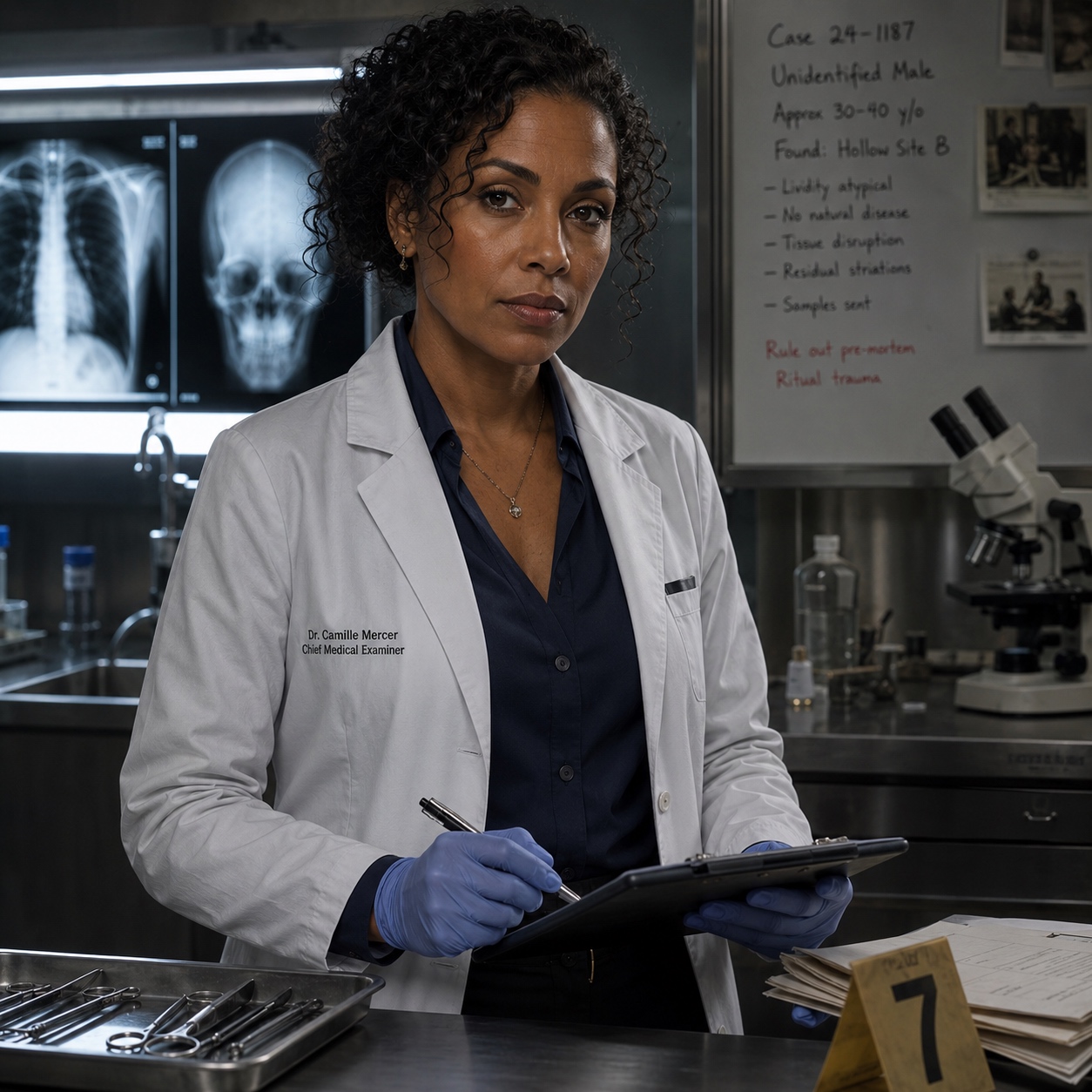
The body tells the truth even when the person it belonged to never did. Mercer built a career on listening carefully to things that can no longer speak for themselves.
Dr. Camille Mercer
Composure Initiative: 6 Corruption: 1 Sanctity: Fully Effective
Background
Camille Mercer has been a forensic pathologist for fourteen years, the last seven as deputy chief medical examiner for a large mid-Atlantic jurisdiction. She is thorough, formally trained, physically precise, and possessed of a dry intelligence that makes her a reliable witness in court and a difficult person to mislead in any professional setting. By this point she is also, frankly, exasperated: bodies keep declining to behave according to established pathological standards.
People arrive expecting a single dramatic case. She tells them, a little coldly, that there wasn't one, and that the question usually says more about the asker than about the work.
What actually happened took eleven years. A ligature mark with no ligature. A drowning recovered from a body with dry lungs. A man whose core temperature climbed for six hours after he stopped being alive. Each one, taken alone, was an outlier, and a pathology career runs on outliers. She wrote every one of them up honestly, filed each under the nearest defensible classification, and moved on, because that is the job and she is good at the job.
She also kept her own copies, and let the question of why sit unexamined for years.
The pattern assembled itself around the eighth year, in a cabinet in her office, out of cases that shared no jurisdiction, no decade, and nothing else except tissue that kept describing an event the world supposedly does not permit. She ran the numbers the way a scientist runs numbers she would prefer to disprove. They held. Science had answered every question she had ever put to it except these, and the honest conclusion was that the category itself was missing, not her instruments.
She requisitioned a better filing system. Shortly after, the Lyncean Office called, and she cooperated the way a person cooperates when they already suspected their filing cabinet was overdue for a better system. Twelve cases with Lyncean involvement later, plus forensic consultation to the Latchkey Archive on two relic-adjacent deaths, and an informal briefing on the Hollow's general structure delivered in terms she could use clinically, she finds the whole arrangement clarifying rather than surprising.
She examines what the field produces, provides the evidence base investigation procedures require, and states with clinical precision what killed the body in front of her, whether or not what killed it should exist by any conventional account. The corpse can lie. The tissue usually tells the truth.
Skills
| Skill | Rating | Skill | Rating |
|---|---|---|---|
| Medicine | 4 | Forensics | 3 |
| Inquiry | 3 | Composure | 3 |
| Discernment | 2 | Deception | 1 |
| Athletics | 1 | Ranged | 1 |
No Faction Passive. Dr. Mercer operates as a civilian expert rather than a faction affiliate. Her professional authority comes from her institutional position (she is a credentialed, court-recognized forensic pathologist) and from her fourteen years of professional standing. She does not have faction resources; she has medical examiner resources, which are different and often more useful in cases with a mundane surface presentation.
Talents
Steady Ground (Iron Will Tree, Tier 1, Chapter Six): When rolling Composure to resist fear, supernatural dread, or panic, Dr. Mercer treats a result of one Success as though it were two. She does not shock easily. She has seen the inside of too many people for that.
Blood Tells Time (Forensics Tree, Tier 1, Chapter Six): On a successful Forensics check, she determines whether a scene was staged before or after the death or injury occurred.
Contradiction Map (Forensics Tree, Tier 2, Chapter Six): She adds 1 Boon die when comparing physical evidence against witness statements, official reports, or received accounts of the same event. Her documentation is admissible, defensible, and procedurally sound.
The Body Refuses (Forensics Tree, Tier 3, Chapter Six): Once per session, when a body's condition cannot be explained by the mundane cause of death on record, she asks the GM what physical law was broken. The GM must name it specifically. This is the talent that took her eleven years to admit she needed.
Equipment
- Lab coat — in examination settings; she does not wear it outside her professional context
- Professional blouse and slacks — the standard she maintains for any situation that requires her credentialed presence
- Medical gloves — she carries multiple pairs; she puts them on before she touches anything
- Autopsy instrument roll — her personal kit, maintained to her own standard; she does not use the facility kit if she can avoid it
- Clipboard with documentation forms — physical forms, pre-printed; she also photographs everything and uses the recorder
- Evidence tray — portable aluminum; her field version for on-site examination
- Digital recorder — she narrates every examination; the recordings are her official working record
- Penlight — high-lumen, for examination use
- Encrypted phone — her Lyncean-consultation contact lives in a separate encrypted partition; her professional contacts and her Lyncean contacts do not share a device
GM Notes
Use Mercer as a recurring expert contact more than a scene participant, though she will show up in a field scene that needs a medical read in real time. She tells the players what killed the body and what the body was before it stopped being one.
Her most important mechanical contribution is The Body Refuses: once a session, the GM must name the specific physical law an anomalous body broke. Design her examinations to be genuinely informative. She should hand the players something they could not have gotten elsewhere.
Her exasperation with anomalous causation is a character note, not a flaw; she is professionally irritated that her classification system has structural gaps, and that irritation should flavor how she delivers findings: clinical, precise, dry about how badly the evidence cooperates with the literature.
Corruption 1 is occupational. She has seen things, documented them, and moved on. The Portland case she consulted on last year is the one she still thinks about, and what she documented there has stayed with her.
Would you like to explain how a man drowns with no water in his lungs? I have four more like him downstairs, and the paperwork only has one box for "undetermined." Dr. Camille Mercer, The Hollow