Father Kostas — The Neptic Brotherhood
Hieromonk, Hesychast Practitioner, Eastern Rite Exorcist
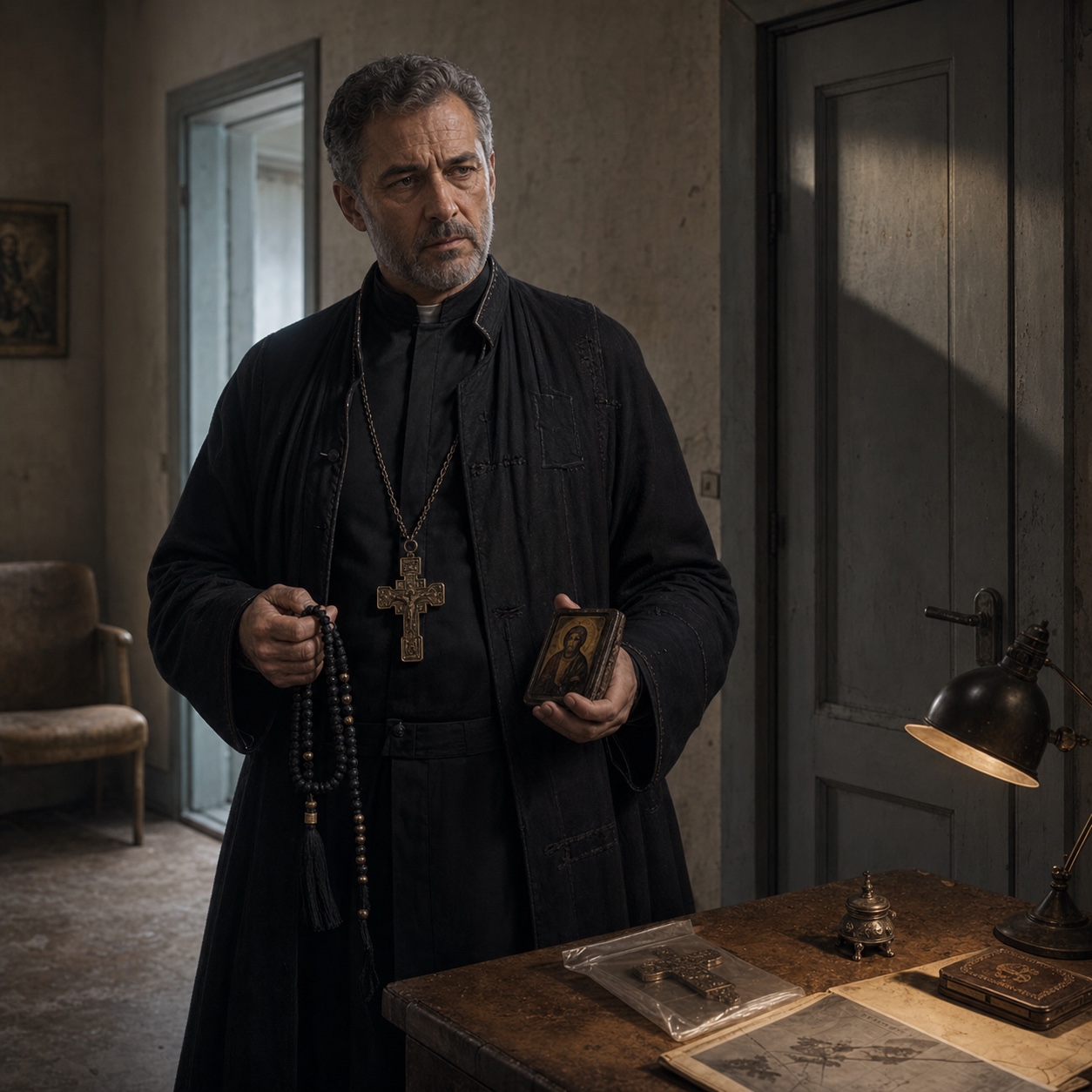
He arrives, says nothing for the first ten minutes, and only then asks his first question. By then he already knows most of the answer.
Father Konstantinos (Father Kostas)
Composure Initiative: 8 Corruption: 0 Sanctity: Fully Effective
Magical Tier Access: Tier 3 Permanent WP spent: 3 (Wound Point maximum reduced from 12 to 9)
Background
Father Konstantinos (Father Kostas to the investigators who work alongside him and to the monks who have known him for thirty years) entered monastic life at nineteen in a skete outside Thessaloniki where the hesychast tradition was still practiced in the form the fourteenth-century fathers intended: not as a historical discipline but as a living one. He was ordained as a hieromonk at twenty-eight, after a formation that his abbot described in the brotherhood's internal record as complete in all the ways the work requires and difficult in all the ways the person requires.
Hesychasm, as the Neptic Brotherhood practices it, is not a contemplative withdrawal from the world. It is a radical and disciplined engagement with the world's spiritual structure: a sustained attention to what is actually present rather than what the practitioner expects to find. The Desert Fathers called it nepsis, watchfulness. The practice, done correctly and long enough, produces a kind of perception that no academic training approximates. Father Kostas has been doing it for thirty-six years. His Discernment, in practice, functions more like an instrument than a skill.
His operational specialty is spiritual assessment: understanding what is in a space, what it is doing, and what the correct procedure is before the confrontation begins. He is not aggressive about the Brotherhood's authority and does not need to be: his exorcism rite is canonically valid, performed under its own ecclesiastical authority, and functionally effective. He does not compare it to the Latin rite in front of Order of Mercy personnel because he considers the comparison unnecessary and the context unconducive to charity. He has his own private assessments about the comparison, which he keeps private.
He has worked with the Order of Mercy eleven times in thirty years. All eleven produced results. None of them produced warmth. He considers this acceptable. The work is not about warmth.
Skills
| Skill | Rating | Skill | Rating |
|---|---|---|---|
| Discernment | 4 | Theology | 4 |
| Composure | 4 | Dead Languages | 2 |
| Research | 2 | Inquiry | 1 |
| Deliverance | 1 | Medicine | 1 |
Charter Trait — The Elder Rite (The Neptic Brotherhood): Father Kostas performs exorcism by the Akolouthia epi daimonizomenon, with additional prayers drawn from the Desert Fathers and the Philokalia tradition, under his own Orthodox ecclesiastical authority. His rite operates at full holy authority independent of the Latin hierarchy. It is not inferior to the Latin Rite. It is different, and the differences occasionally matter: certain entities with specific theological associations respond differently to the Eastern tradition's framing, and Father Kostas knows when this applies.
In regions where Orthodox Christianity is historically dominant (Eastern Europe, Greece, the Middle East, Egypt, Ethiopia) Father Kostas has access to the Orthodox Church's local infrastructure that the Order of Mercy cannot reach through its institutional channels: Orthodox churches, monasteries, holy sites, clergy networks. What the Order cannot access through official channels, he can walk into through a phone call.
The hesychast discipline provides an additional effect on all spiritual assessment: Father Kostas may reduce the difficulty of Discernment checks by 1 step. Watchfulness, practiced long enough, produces accuracy that training alone does not.
Talents
Father Kostas's authority runs on an Eastern line, but the mechanics are the standard Chapter Six trees. The hesychast tradition is how he acquired them, not a separate rules system.
Opening Rite (Exorcism Tree, Tier 1, Chapter Six): Father Kostas may lead a formal exorcism against an established possession, and during Stage 1 (Diagnosis) identify whether a possession is partial, full, feigned, or externally anchored. The Neptic Brotherhood's rite is not the Roman one, but it is a sanctioned rite and it satisfies the same requirement.
Compel Manifestation (Exorcism Tree, Tier 2, Chapter Six): During Stage 3 (Binding) or Stage 4 (Confrontation), he can force a possessing entity to produce a sign, react audibly, or reveal leverage information. It cannot fully conceal itself from him once rite contact is established.
Litany of Pressure (Exorcism Tree, Tier 3, Chapter Six): During Stage 4 (Confrontation), he may spend Boon results from rite checks to reduce the entity's next resistance roll, add Bane dice to its next action, or recover one step of procedural progress. Thirty-six years of sitting in silence with difficult presences is what this talent looks like on a man who is never in a hurry.
Still Small Warning (Discernment Tree, Tier 2, Chapter Six): Once per session, when in proximity to a person, place, or object that is spiritually wrong in a way he has not yet identified, the GM warns him that something is wrong. Not what. Not where. Just that.
Inverted Sign (Discernment Tree, Tier 3, Chapter Six): Father Kostas can identify whether a miracle, vision, holy-seeming event, or spiritual experience has been inverted, mimicked, or counterfeited by a supernatural source.
Pressure Holds (Iron Will Tree, Tier 2, Chapter Six): Once per session, he may ignore the mechanical effects of a failed Composure check. The fear comes. He sits with it. The fear leaves. He is still there.
Equipment
- Black cassock and riassa (outer robe): travel-worn and extensively repaired; he has been wearing essentially this outfit for thirty years and considers a different appearance an unnecessary complication
- Pectoral cross: heavy brass, worn over the cassock at the chest; not a weapon; he would not use it as one; he does not need to explain why
- Prayer rope (chotki): black wool, knotted at one hundred knots; he prays it constantly; in tense situations, investigators who watch him will notice the rope moving through his fingers regardless of what else he is doing
- Epitrachelion; his priestly stole, folded into a compact form and carried for formal liturgical functions; he will not conduct his rite without it
- Liturgical oil, kept in a small sealed silver vessel; for unction and blessing; he refills it from blessed sources when passing through Orthodox communities
- The Philokalia: a heavily annotated Greek-language copy, fourth edition, extensively marked in red and black ink across four volumes consolidated into a reading order that makes sense only to him
- Small travel icon of the Theotokos, in a leather case: the icon is old enough to be materially significant and he knows it; he handles it accordingly
- A notebook in Greek, spiral-bound, filled with operational assessments in a hand that is very small and very clear
GM Notes
Let Father Kostas slow the table down on purpose. He is usually right to. His best scene costs the investigators something minor, time, a lead, a confrontation window, and then reveals that the delay prevented a catastrophe. Design that scene at least once in any campaign that features him, and let the players feel both halves: the frustration of waiting, and what the waiting bought them.
His Discernment at 4, with talent and Charter Trait reductions, makes him the most sensitive spiritual assessment instrument in most investigative teams. He tells investigators what is in a room before they enter it, what the entity wants, and whether the preparation is complete. That function carries real weight in a team.
The Order of Mercy friction is worth threading through any case where both appear. Kostas declines to defer to an Order priest on matters of spiritual authority, and he is canonically correct to decline. He is also a monk, not a brawler, so the refusal comes wrapped in courtesy: precise theological language, a polite refusal to recognize a jurisdictional claim he does not believe has jurisdiction, and then a return to his prayers while the Order priest works out what just happened.
His Composure at 4 and Willpower at 4 make him the hardest character in the full roster to break psychologically. An entity running a Confrontation against him at Stage 4 will find the standard interference tactics expensive and ineffective. He has been sitting in silence with difficult presences for thirty-six years. He is not surprised by any of them.
We do not hurry. The thing we are addressing has been here longer than the urgency you are feeling. It will still be here after the urgency passes. Prepare correctly or do not begin. Father Konstantinos, The Hollow