Pastor Caleb Stroud — The Watchfires
Protestant Deliverance Worker
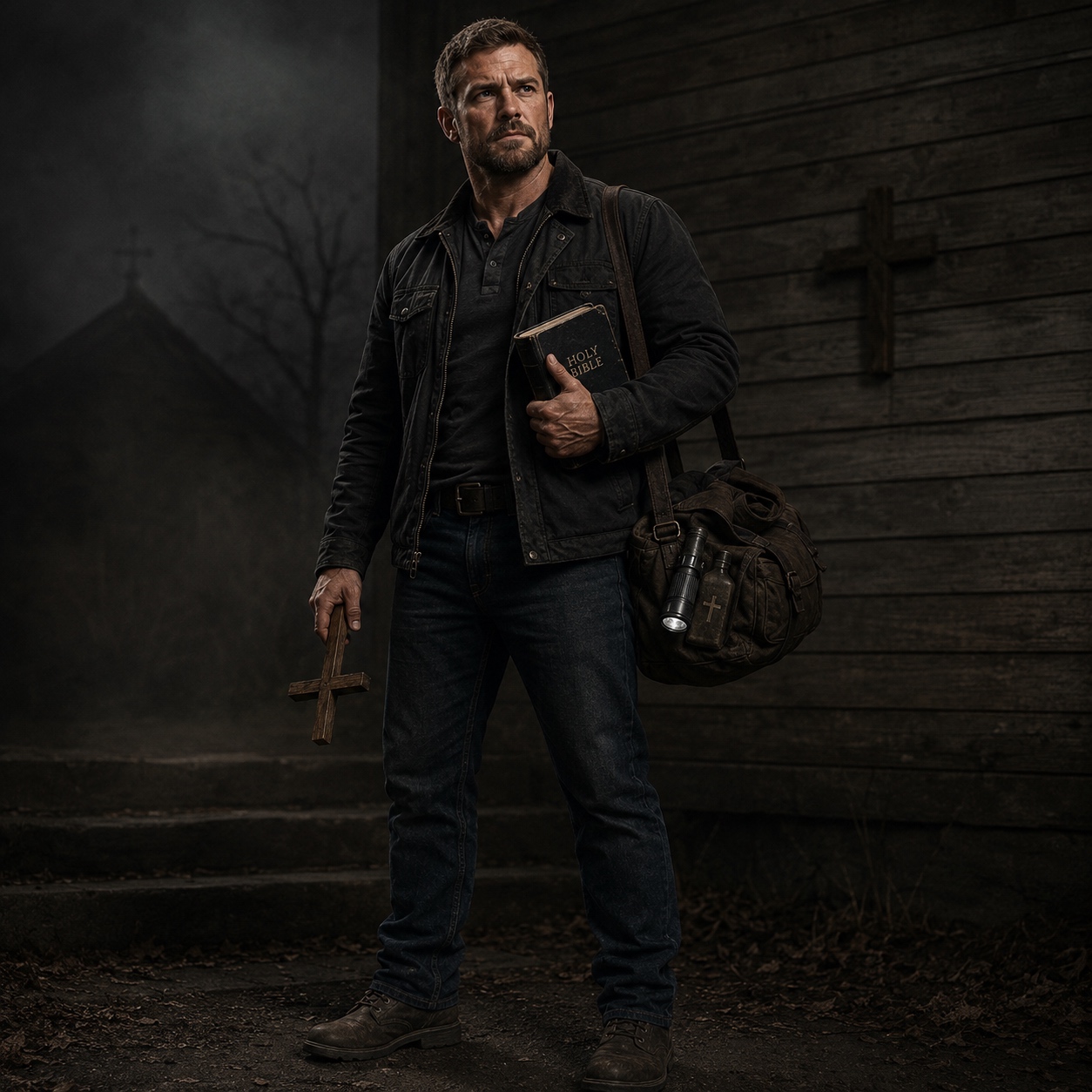
You want to know if he was scared. Sure he was scared. Being scared was never the question he had to answer.
Pastor Caleb Stroud
Composure Initiative: 7 Corruption: 1 Sanctity: Fully Effective
Passion: Protecting the innocent from what feeds on them
Background
Caleb Stroud spent six years as a youth pastor in a mid-sized Protestant congregation in rural Tennessee before a hospital room changed what he thought the job was. A teenager from his youth group had been exhibiting behavior the family called a breakdown and the medical staff called dissociation. Stroud sat with the boy through three nights before something spoke to him directly, in the boy's voice, using Stroud's own name, and told him three things about his past that no living person could have known.
He stayed anyway. He still could not tell you exactly why. He prayed the way a man prays once he has stopped performing it and reached whatever is underneath, and whatever was using the boy's voice went quiet long enough for help to arrive. The boy recovered. Stroud resigned from the congregation a month later, not because he had lost his faith but because he had found a version of it that no longer fit a Sunday service.
For four months afterward he went looking on his own: had this happened to anyone else, and who dealt with it when it did. He asked around, quietly, until someone finally handed him a phone number for something called the Watchfires. He trained for a year, Righteous Fire discipline, deliverance procedure, field protocol, and has been active ever since, without the institutional authority of the Catholic exorcists, without the sacramental structure, without centuries of documented procedure behind him. What he carries instead is a Bible read down to the margins, a conviction that nothing in a room outsizes what he brought into it, and nineteen successful deliverance interventions on the record.
He does not claim a priest's tools. He claims a plainer kind of certainty, and he has never found it wanting.
Skills
| Skill | Rating | Skill | Rating |
|---|---|---|---|
| Righteous Fire | 3 | Theology | 3 |
| Composure | 3 | Deliverance | 3 |
| Athletics | 2 | Melee | 2 |
| Streetwise | 2 | Inquiry | 1 |
Faction Passive — Passion (The Watchfires): Stroud's Passion is protecting the innocent from what feeds on them. When he takes action directly in service of this Passion, shielding a target, driving back an entity that is using a person as leverage, or intervening to remove someone from immediate supernatural harm, after seeing the roll he may suffer Strain to add successes to the result. The first added success costs 3 Strain; each further success on the same roll costs 1 more (3, then 4, then 5, and so on), and he can never spend past what would incapacitate him. The Passion must be genuinely engaged, not incidentally adjacent to the action.
Key Skill — Righteous Fire 3 (Hard-Gated Authority): Righteous Fire is Stroud's primary supernatural authority. It is a skill, not a magical talent, and it resolves exactly as printed in Chapter Eight: rolled as Willpower + Righteous Fire, it disrupts a demonic entity's hold on its target, suppresses a possessing entity's agency for one round while a formal exorcist works, restores compromised holy authority for a scene, or refuses a single devil contract enforcement. His Passion applies to any of these rolls.
Talents
Incorruptible (Iron Will Tree, Tier 4, Chapter Six): When Stroud would gain 1 Corruption from an environmental or accidental source (proximity to a high-stage Wound, a passive infernal effect, an unconsented contact), he makes a Willpower check at Average. On success, he does not gain it. He has absorbed things that would have marked someone less grounded.
Covered (The Long Vigil Tree, Tier 2, Chapter Six): Stroud designates one character as his charge for the scene. While he remains within Engaged range, that character adds 1 Boon die to resistance checks against supernatural pressure, possession attempts, or demonic influence directed at them. The designation ends if he falls or leaves the scene. He does not leave.
Calm the Room (Commanding Presence Tree, Tier 1, Chapter Six): When Stroud uses Leadership to redirect panic, fear, or chaos in bystanders or allies, he adds 1 Boon die to the check. He carries no credentials. He carries presence.
Equipment
- Dark work jacket — heavy canvas, worn-in; practical in any field environment
- Underlined Bible — extensively annotated; Stroud can locate any verse in under ten seconds; specific passages are marked for read-aloud use during deliverance work
- Plain wooden cross — not consecrated in the Catholic sense; carries whatever weight Stroud brings to it, which is considerable
- Duffel bag with field supplies — salt (iron-reinforced), blessed cord, small iron shavings, candles, several additional paperback reference works
- Flashlight — heavy-duty; he has used it as a weapon and is not embarrassed about this
- Light Pistol — center-grip, standard rounds; he shoots well and has never liked that about himself
GM Notes
Play Stroud as the character with nothing behind him but the work itself: no Order, no hierarchy, no paperwork trail. What he brings instead is speed and a track record.
He works well as a first responder, already three hours into a scene by the time an Order representative arrives with a briefcase. He and Father Vale can share a room without either man needing to win it; the friction between them stays professional.
His Passion is the most mechanically active line on his sheet. Give him real people to protect and a real cost for protecting them, or the mechanic never earns its keep.
Corruption 1, and nothing is pushing it yet. He has more room to fall than most characters in this book before anything changes.
I had no rite, no bishop, and no idea what I was doing. I stayed in the chair. That turned out to be the whole of the job. Pastor Caleb Stroud, The Hollow