In This Chapter
This chapter defines the three active supernatural systems available to characters in The Hollow: Holy Power and Rites, Exorcism, and Spirit Banishment. It also defines the Corruption Track in full, how it accumulates, what thresholds mean in play, and how it interacts with Devil Deals.
The Shape of Power
The Hollow contains real supernatural power on both sides of the conflict. Angels, demons, devils, and spirits all operate by rules older than human civilization, and characters encounter those rules and, in some cases, act within them: holy power through sanctioned office (defined below), corruption as debt taken on against a character's own spiritual integrity (defined in The Corruption Track). Both directions tempt. Greater holy authority demands more of the one who holds it; shortcuts cost more than they first appear.
The War Is Real
Spiritual warfare in The Hollow is literal (Chapter Two). An exorcist confronts an entity that does not want to leave, that has claims it will assert, and that is capable of harm; a character who gains Corruption has been marked by something spiritually real.
Holy Power
What Holy Power Is
Holy power is the mechanical expression of sanctioned spiritual authority, and it operates through presence, office, and integrity rather than through any personal reserve. Characters do not run out of holy power the way they run out of ammunition. A priest does not generate holiness; a priest operates within a sanctioned office, draws on its authority, and exercises that authority against forces that recognize it.
A character exercises holy power by:
- Performing rites, blessings, or sacraments within their sanctioned authority
- Applying holy or blessed objects in situations of actual spiritual conflict
- Invoking divine authority through prayer, command, or consecration
- Standing as a spiritual authority in a contested space
The mechanical expression of holy power appears in skill checks, talent effects, and the properties of holy equipment described in Chapter Seven. This chapter defines the conditions under which those expressions activate and how they interact with supernatural entities.
Sanctity
Sanctity is the quality that makes holy power effective: a relationship status between a character and the spiritual authority they represent. There are no Sanctity points to gain or lose. The GM uses the following guidelines to determine whether a character's holy authority is functioning at full effectiveness, diminished effectiveness, or not at all.
What counts as a holy authority check. A holy authority check is any check that invokes sanctioned spiritual power rather than ordinary skill or knowledge: Sacraments; formal blessings and consecrations; the Exorcism rite at every stage; Deliverance used to aid another against demonic influence; Righteous Fire; and any talent drawn from the Consecration, Exorcism, or Spirit Banishment trees. Ordinary uses of Theology, Discernment, Research, or similar skills are not holy authority checks even when the subject is spiritual; the Sanctity and Corruption penalties in this chapter apply only when the character is wielding holy power as such.
A character's holy authority is fully effective when:
- They are acting within the scope of their sanctioned office (ordained clergy in a rite; a faithful believer in prayer; an exorcist in a formal exorcism)
- Their Corruption Track is below 5
- They have not recently violated a direct moral boundary tied to their authority (within the current session or, at GM discretion, recent sessions)
- The rite or action is appropriate to the threat being addressed
A character's holy authority is diminished when:
- Their Corruption Track is 5–6 (add 2 Bane dice to all holy authority checks)
- They are operating outside their technical sanctioned scope but within honest spiritual intent
- They have made a serious moral compromise in the current session (GM judgment; the specific effect depends on severity)
A character's holy authority is severely diminished when:
- Their Corruption Track is 7–8 (add 3 Bane dice to all holy authority checks; this replaces, not stacks with, the 5–6 penalty)
- Command effects (compelling an entity to answer, withdraw, or be bound in God's name) are unavailable at this level regardless of other conditions
A character's holy authority is suspended when:
- Their Corruption Track is 9 or higher (holy authority checks automatically fail until Corruption drops below 9, or until a GM-approved narrative intervention, a significant act of spiritual restitution, occurs)
- They are acting in direct bad faith: performing a rite while knowingly operating under a devil's contract to undermine it
The Corruption penalties above are restated with their full threshold effects under Corruption Thresholds in Play, later in this chapter, which is the governing text. Sanctity can be lost, but not easily; the GM should reserve suspended holy authority for moments of true spiritual crisis, not as punishment for difficult choices.
The Corrupt Exorcist Problem
What happens when a character with Corruption 7 tries to perform an exorcism? They can try. The rite proceeds. But demons notice the mark on them, and they will use it, naming the compromise, bargaining with it, attempting to turn the exorcism into a negotiation. The character is not locked out of holy work. But they are walking into it compromised, and the thing they are confronting knows it. This is a story opportunity, not a mechanical dead end.
Blessed Items and Holy Objects
When a character uses a holy or blessed item in actual spiritual conflict, the item functions as described in Chapter Seven. The following additional rules apply:
Anyone can use a holy item: the item's properties are not locked to the faithful. A Candleless occultist can throw holy water at a demon and it will burn. However, certain effects require an authorized user:
- Consecration effects (turning a space, creating a sustained barrier, sealing a location against re-entry) require Theology 1 or higher.
- Sacramental effects (Anointing of the Sick, Last Rites with full mechanical benefit, Eucharist as spiritual fortification) require ordained status (Order of Mercy, or GM-approved equivalent spiritual authority). For practitioners from non-Catholic Christian traditions, equivalent authority is based on whether the tradition confers the equivalent rite with real institutional weight: Orthodox clergy fully qualify; Protestant ministers with formal sacramental authority qualify at GM discretion.
- Command effects: compelling an entity to answer, withdraw, or be bound by the name of God, require the invoking character to have no active devil contracts and Corruption below 7.
Items are consumed or expended as noted in Chapter Seven. Expended holy items may be reconsecrated through appropriate ritual, which requires a Theology check (Average for simple blessed items; Hard for specialized or high-grade items; Severe for major consecrated objects).
Rites and Ritual
What a Rite Is
A rite is a structured supernatural action with formal components: words, materials, and physical procedure, producing a real spiritual effect when performed correctly by an authorized practitioner. A correctly performed blessing changes the spiritual status of an object; a correctly performed exorcism confronts and expels a possessing entity.
A quick prayer before entering a dangerous building is not a rite, and neither is reciting the Twenty-Third Psalm at a ghost. Acts like these are meaningful: they express faith, calm fear, and may comfort the dying, but they do not produce structured supernatural effects.
Rites require:
- Time: most rites cannot be rushed (see individual procedures below)
- Materials: ritual supplies as listed in Chapter Seven
- Authority: the character must have the skill rating and faction authority appropriate to the rite
- Intention: the character must understand what they are doing and why. Performing a rite from a script without comprehension produces nothing. (This is why research skills matter: a character who understands the theology of what they are doing performs better than one who is following instructions.)
The Rite Procedure
When a character performs a rite, use the following structure:
1. Preparation. The character gathers materials, establishes the space, and performs any prerequisites (identifying the threat, clearing bystanders, etc.). No check required unless the environment is actively contested.
2. Declaration. The character names what they are doing and against what. The GM confirms the rite is appropriate to the threat. A Theology check may be called here if there is real ambiguity about what kind of entity or threat is present.
3. Performance. The rite proceeds as a structured check or extended check, depending on complexity (see individual rite rules below). Disruption during performance requires a Composure check or the rite fails; any failure in an extended check may also require a recovery roll before the rite can continue.
4. Resolution. The effect is applied. If the check succeeded, the rite works. If the check failed, the rite does not produce its intended effect. Boon spends and Bane complications both apply during rites, a Breakthrough on a blessing may produce an unusually durable effect; a Calamity may produce a dangerous spiritual backlash.
Sacraments (Order of Mercy)
The sacraments are a distinct category of rite available only to ordained clergy or those acting under explicit sacramental authority delegated by ordained clergy. Sacraments produce the following specific mechanical effects in The Hollow:
Last Rites / Anointing of the Sick. When performed on a living person who is dying or in spiritual crisis, reduces Corruption by 1 (if the recipient consents). Requires Theology 2 and ordained status. Materials: anointing oil, stole, sacramental prayer text. Time: 10 minutes.
Confession and Absolution. When administered to a character who genuinely discloses and repents of a specific moral failing, may reduce Corruption by 1 (GM judgment on whether the disclosure is genuine). Requires ordained status. Time: variable. No materials required.
Eucharist. When the Eucharist is offered in a contested or corrupted space and received by a faithful practitioner, grants +1 Boon die on all spiritual resistance checks for the remainder of the scene. Requires ordained status to administer, any character to receive. Materials: consecrated host and wine. Time: abbreviated rite, 5 minutes.
Exorcism Mandate. A formal mandate of exorcism given by appropriate ecclesial authority to a designated exorcist. In The Hollow, this is represented by the Order of Mercy's Rite of Office passive, when an exorcism is conducted under a valid mandate, the exorcist receives the full bonus from their passive benefit.
Improvised Sacraments
A character trained in Theology but not ordained can attempt to administer sacraments in an emergency, when a person is dying and no ordained minister is available. This is not technically unauthorized; the Church has long recognized that certain sacramental acts may be performed by laypersons in extremis. Mechanically: the check proceeds at Hard instead of 2, without the ordained bonus. The effect, if successful, is real.
Consecrating a Space
Consecration changes the spiritual status of ground. On consecrated ground, possession cannot be established, and a demon expelled at Strain 0 dies instantly (see Chapter Twelve). Entities whose entries reference consecrated ground interact with it as those entries state. Consecration is the strongest passive defense available to investigators, which is why the rite is demanding.
Field consecration (temporary). A character with Theology 1+ may consecrate a small, defined space: a room, a vehicle interior, a marked perimeter. Materials: holy water and a rite text (GM may waive the text at Theology 3+). Time: 15 minutes. Check: Willpower + Theology, Average for spiritually neutral ground, Hard if the site has hosted recent supernatural activity. On success, the space is consecrated until the end of the scene, or for one day if the space remains undisturbed.
On failure, the space is not consecrated and the attempt may be repeated after the materials are renewed. On a Calamity, something took note of the attempt: the GM introduces a spiritual complication and the site cannot be re-attempted until the next day.
Permanent consecration. Requires ordained status (Order of Mercy or GM-approved equivalent), Theology 2+, a full rite of one hour, and materials (holy water, anointing oil, rite text). Check: Willpower + Theology, Average for neutral ground, Hard for a site of recent supernatural activity, Severe for corrupted ground. On success, the consecration holds indefinitely unless the ground is deliberately profaned. Failure and Calamity results are as for field consecration.
An active Wound Site cannot be consecrated by either rite; addressing a Wound is the province of the Reclaim the Wound talent (Chapter Six) and the escalation rules in Chapter Ten. The Sanctify Ground talent (Consecration tree, Chapter Six) creates a lesser holy zone quickly and without the full rite; it does not confer full consecrated status.
Possession: The Three Conditions
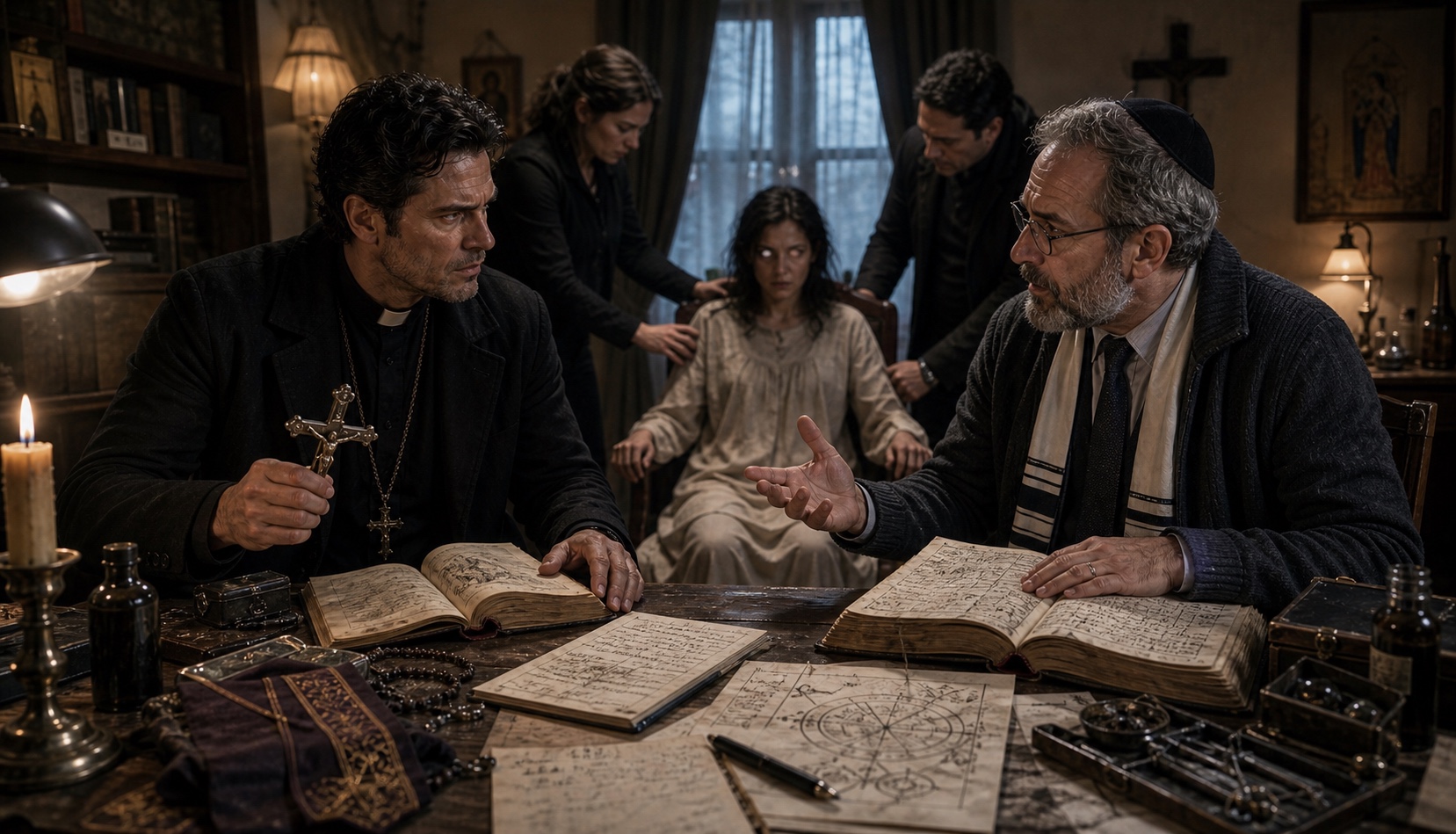
When a supernatural entity takes residence inside a living human being, the condition is called possession. Possession occurs in three distinct forms, each requiring different expertise to identify and different procedure to address. What they share: the host's body is no longer entirely their own, and that state has a cost.
The Three Types
Demonic Possession. A fallen angel has entered a human host by invitation, exploitation of spiritual vulnerability, or through the mechanism of an active Wound Site. The demon is not human. It has no history in the body it has claimed. It uses the host instrumentally: as a vehicle, a weapon, a site of suffering. It does not mourn the host. It does not know what mercy is.
Addressed by: Exorcism. Expulsion returns the demon to hell. Strain 0 expulsion without a viable host results in permanent demon death rather than return to hell; see Demonic Possession, Chapter Twelve.
Dybbuk (DIH-buk; from Hebrew דִּיבּוּק, "to cling"). A human spirit that has attached itself to a living person without consent. Dybbuks were once people. They carry the recognizable architecture of a human soul: memory, emotion, sin, desire, grief. Most are wandering spirits that have not found passage to their proper destination. Some have escaped from hell, carrying the full weight of their damnation into a host. Some have been cast out from purgatory as a final test of their character, given a window to prove or condemn themselves through action in the living world. What all dybbuks share is that they have entered without consent, and their presence does violence to the host's spiritual integrity regardless of their intent.
A dybbuk possessing someone will imprint its dominant emotional or spiritual state onto the host. A hell-escaped soul weighted with the sin of envy will make the host burn with it: covetous, diminished, obsessive. An anguished purgatory castout will make the host feel its grief as their own. The host experiences these states as authentic, which is part of what makes dybbuks so difficult to identify from the outside. The host is not performing the state. They are living inside it.
Addressed by: Spirit Banishment (dybbuk procedure); for exorcism applied in error, see Wrong-Tool Consequences.
Ibbur (IH-boor; from Hebrew עִיבּוּר, "passing through"). A human spirit possessing a living person with a redemptive or transitional purpose. The ibbur is attempting to complete something: righting a wrong it was responsible for, protecting someone it failed, finishing something it left undone. By spiritual law, possession without consent is a violation regardless of intent, however good the ibbur's reasons.
An ibbur will make the host exhibit qualities higher than their own: unusual courage, sudden compassion, skill in something they never studied. The host may not understand why they are different. Bystanders will notice the change. Discernment reads an ibbur as possession, but the spiritual signature is cleaner than a dybbuk (the presence feels like a lift rather than a weight), which is the only reliable in-field tell for investigators without specialized expertise.
If the host is willing (has agreed, however informally, to the ibbur's presence), the ibbur will submit to that host, allow them to speak first, and cooperate with those who address it. A willing ibbur in a willing host is the best-case scenario. It is also exactly what an intelligent, deceptive soul would perform. The Lamed Vav can tell the difference (see Identifying Possession Type, below); most other factions cannot.
Addressed by: Reconciliation for a willing ibbur in a willing host (see below); Spirit Banishment (dybbuk procedure) for an unwilling ibbur or a contested case. For exorcism applied in error, see Wrong-Tool Consequences.
Identifying Possession Type
Discernment confirms that something supernatural is present inside a person. It cannot alone determine what type.
Theology or Monster Lore (Hard ) can distinguish demonic possession from human-soul possession in most cases. Severe if the entity is actively concealing its nature.
The Lamed Vav's Weight of Names Charter Trait provides identification certainty on first examination: demonic, dybbuk, or ibbur, and further, whether the dybbuk is an escaped hell-soul, a cast-out purgatory soul, or a wandering liminal presence. This is expertise no other faction can reliably replicate without the Lamed Vav's specific archive access.
Misidentification is the most common cause of catastrophic outcomes in possession cases. The wrong procedure applied with full authority and skill is worse than no procedure at all.
Possession: Resistance and Ongoing Control
The complete rules for demonic possession resistance, ongoing control checks, Strain economy, modes of possession, the escalation ladder, Rushed Possession, demon death, Spiritual Kill Marks, and Subjugating the Demon are in Chapter Twelve: Running The Hollow (Demonic Possession section).
The short version for reference: possession is an opposed check (victim's Willpower + Composure against the demon's Willpower, upgraded by Possession skill ranks). The demon must win by at least 1 net success. Once inside, the demon uses one-sided control checks against a fixed difficulty based on how extreme the action is, paying Strain on bane results. A character with Awakened Blood is not immune to possession but always registers the attempt and may make a full resistance check. A character with Deliverance rank 1+ may add their Deliverance rank as bonus dice to their resistance pool if aware the attempt is occurring.
Exorcism
What Exorcism Addresses
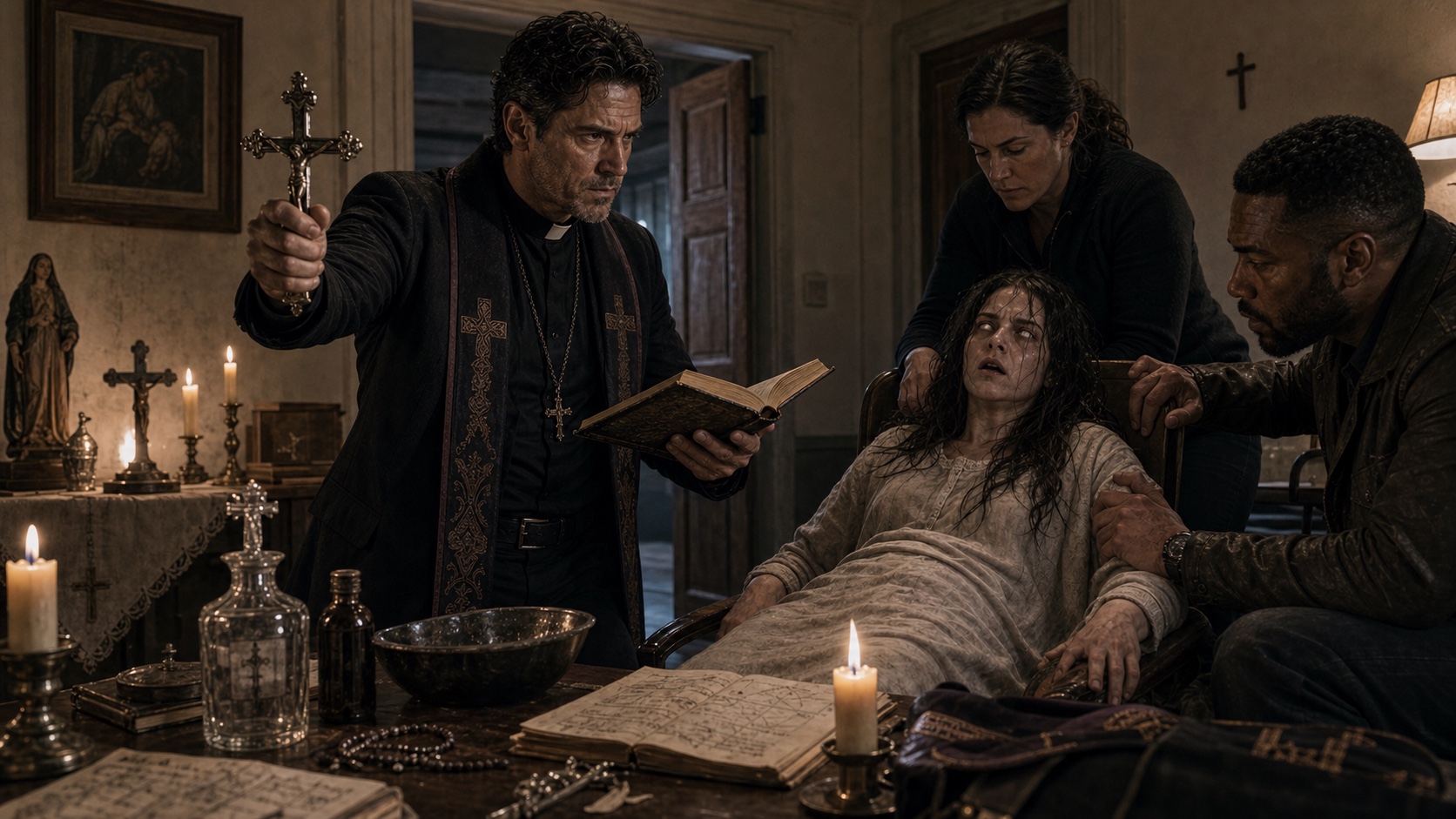
Exorcism is the formal process of confronting and expelling a demonic entity that is possessing, oppressing, or infesting a person, place, or object. It works only on demonic entities: fallen angels operating within a host or location through the mechanism of possession. Applied to a ghost or spirit, it produces no meaningful effect and may agitate the entity; applied to a dybbuk or ibbur, it causes serious harm to everyone involved (see Wrong-Tool Consequence: Exorcism on a Human Soul).
Types of Demonic Presence
Infestation. The entity is present in a location or object but not possessing a person. It may manifest through environmental effects, cold spots, interference, physical phenomena. Infestation exorcism addresses the location or object rather than a host.
Oppression. The entity is influencing a person from outside: not fully inside, but in constant proximity. The affected person may show signs of psychological distress, spiritual disruption, or physical symptoms. They retain full agency but are under sustained supernatural pressure.
Possession. The entity is fully inside the host, sharing or displacing the host's consciousness. Full possession is the most severe and most rare form. Partial possession (where the entity has gained a foothold but the host still has some access to their own will) is more common and is the ground on which most exorcisms are fought.
The Exorcism Procedure
Exorcism is a multi-stage extended check requiring multiple distinct actions. The stages must proceed in order. Failure at any stage does not end the exorcism but triggers complications. Characters may not skip stages.
To lead this procedure, a character must possess the Opening Rite talent (Exorcism Tree, Tier 1, see Chapter Six). Without it, a character may assist another's exorcism but cannot direct the rite themselves. Magical Tier Access (1 permanent WP) and Deliverance rank 1+ are required to purchase Opening Rite.
Stage 1: Diagnosis (Intellect or Willpower + Theology, Discernment, or Perception)
Before any formal exorcism can begin, the exorcist must correctly identify what they are confronting. This requires a check using Intellect or Willpower + Theology, Discernment, or Perception (whichever pairing is highest) against a difficulty equal to the entity's Concealment (see Chapter Eleven). If the entity has suppressed evidence or the host is cooperating with it, increase the difficulty by one step. Success confirms entity type (demonic, and if the exorcist has Monster Lore or Discernment 3+, they may learn additional details about the entity's category and potential names). Failure means the exorcist proceeds with incomplete information; the GM introduces a complication at Stage 3 reflecting the gaps in their knowledge.
Stage 2: Preparation (Theology + Setup)
The exorcist prepares the environment, establishes the rite perimeter, and consults their research. This stage is primarily procedural but a check may be required if the environment is contested or if the exorcist is working from incomplete materials. Success at this stage grants +1 Boon die on Stage 3.
Items required: holy water, liturgical vestment (stole for ordained exorcists; scapular or veil for religious sisters and other non-ordained authorized exorcists), consecration tape or salt perimeter, prayer text or rite manual (GM may waive if exorcist has Theology 4+), any relevant research materials. Time: 15–30 minutes unless interrupted.
Difficulty: Easy (stable environment, full materials); Average (contested environment, partial materials); Hard (entity is actively disrupting preparation)
Stage 3: Binding (Willpower + Deliverance vs. Entity)
The exorcist issues the formal command for the entity to be still. This is the first direct confrontation. The entity resists. This is an opposed check: the exorcist rolls Willpower + Deliverance; the entity rolls its own Willpower. If an entity entry lists a special defense for this stage, use that entry's rule.
On a Success with Boon, the entity is bound and disoriented: the exorcist gains +1 Boon die on Stage 4 and the entity loses one action in the following round if the exorcism is interrupted by violence.
On a Success, the entity is bound but not disoriented: Stage 4 proceeds normally.
On a Failure, the entity has resisted the binding. It is not expelled or even suppressed; it may speak, retaliate through the host, or begin extracting information. The exorcist may attempt Stage 3 again after addressing the complication (restoring disrupted materials, steadying a panicked team member, etc.), but each reattempt costs 10 minutes and gives the entity an additional action.
On a Calamity, the entity breaks the attempted binding and escalates: the host takes 1 Wound, the GM introduces an environmental complication, and the exorcist must succeed at a Composure check (Average ) or lose their next action.
Stage 4: Confrontation (Willpower + Theology, Extended Check)
This is the heart of the exorcism: the extended contest of will, authority, and spiritual argument. The exorcist invokes divine authority, names the entity's sin, demands its departure, and refuses to be turned from the work.
The Confrontation is an extended check with a target of 3 successes. Each check represents approximately 10–15 minutes of active exorcism. The check uses Willpower + Theology (or Willpower + Deliverance if the exorcist has Deliverance 3+, whichever is higher).
Difficulty: Average for standard demonic entity; Hard for a named demon; Severe for a high-order entity (rare)
During this stage, the entity will attempt to interfere. Between each check, the GM may have the entity:
- Bargain: offer something real and valuable in exchange for the exorcist stopping. The offer is real: if any character at the table accepts, the exorcism fails and the acceptance costs 2 Corruption.
- Accuse: name a real sin or compromise of the exorcist or a supporting character. No mechanical effect, but a Composure check (Average ) is required for the target character to maintain focus.
- Speak a Name, if it has learned through Diagnosis failure that the exorcist has incomplete knowledge, it may introduce false information, provide a partial true name as a red herring, or name a vulnerability.
- Escalate: increase harm to the host. Each escalation causes 1 Wound to the host. This is the entity's primary coercive leverage.
Characters assisting the exorcist may use their actions to provide Aid checks (using Theology, Composure, or Willpower) to contribute to the extended check's success count.
If the exorcist accumulates 3 failures before 3 successes, the exorcism fails and the entity is not expelled. The entity retains its position, the host is harmed (2 WP damage from the failed attempt), and the entity has learned things about the exorcists that it did not know before. A failed exorcism may not be immediately re-attempted; a rest period and a new preparation (Stage 2) are required.
Stage 5: Expulsion (Willpower + Deliverance)
The final command. The exorcist, having accumulated sufficient authority through the Confrontation, issues the formal command of expulsion by name. This is a single check. Willpower + Deliverance, against the entity's final resistance.
Difficulty: as listed in Chapter Eleven. Minor (Tier 1): Easy ; Significant (Tier 2): Hard ; Major (Tier 3): Extreme
On Success, the entity is expelled. The host collapses, confused and exhausted. Recovery time and lasting effects depend on how long the possession lasted and how much harm occurred (see post-exorcism recovery below).
On Failure, the exorcist has authority but not yet sufficient force. The entity is not expelled but is now weakened: revert to Stage 4 and accumulate one additional success beyond the three already held, then attempt Stage 5 again. The prior three successes are not lost; only one more is required. If the exorcist has Deliverance 3+, they may spend a Boon die from that Stage 4 check to reroll Stage 5 once.
On Breakthrough, the expulsion is complete and the entity is not merely expelled but diminished. It cannot attempt to return to this host without significant preparation (months, not days), and the GM may allow the exorcist to learn the entity's true name as a bonus.
On Calamity, the entity resists catastrophically: it leaves the host but is not diminished, and it attempts a Rushed Possession of the highest-Willpower target in the room. All Rushed Possession rules apply (see Chapter Twelve): the target uses their standard Willpower + Composure plus any applicable modifiers, and the demon applies no situational bonuses.
Name Leverage in Exorcism
Partial true name. A fragment of an entity's true name (a syllable, a title, an epithet, a historical name, however obtained) may be invoked during the rite. While it is being invoked, the entity's opposing pool at Stage 3 (Binding) suffers 1 Bane die , and each Stage 4 interference action costs the entity 1 additional Strain. Partial-name leverage is knowledge, not a talent: any exorcist who holds the fragment may invoke it. Talents from the True Name tree (Chapter Six) provide their own distinct benefits and apply in addition to this rule.
Full true name. An entity whose complete true name is known can be commanded directly at Stage 4: reduce the difficulty of all Stage 4 checks by one step. The Speak the Name Entire talent (Chapter Six) extends true-name leverage beyond exorcism.
Post-Exorcism Recovery
A successfully exorcised host recovers according to the severity and duration of the possession. In all cases, the host is disoriented, exhausted, and emotionally vulnerable immediately after. The exorcist or a medic may provide support (Medicine or Theology check, Easy ) to stabilize the host.
-
Short oppression (days to weeks): Full psychological recovery likely with time. No permanent mechanical effects.
-
Extended possession (weeks to months): The host retains fragmented memories of the possession. The GM may introduce Strain or Wound complications that require medical or spiritual care to address.
-
Long-term or severe possession (months or longer): Lasting effects are likely. The host may require ongoing spiritual care and may have had parts of their personality or memory damaged; treat these effects as story, defined by the GM rather than by mechanics.
Multiple Exorcists
Additional trained characters can assist an exorcism:
- A second character with Deliverance 1+ may add an Aid check during Stage 3 and Stage 5.
- Any character may provide Aid during Stage 4 using Theology, Composure, or Willpower.
- A character maintaining the perimeter (guarding against physical interruption, managing bystanders, holding the prayer environment stable) provides +1 Boon die to all Stage 4 checks as long as they remain focused and the perimeter is intact.
Exorcism and the Factions
The Order of Mercy trains most formally for exorcism, but the procedure belongs to anyone with the authority, the preparation, and the willingness to see it through. Watchfires exorcists use the same skills and the same procedure, with Righteous Fire supplementing formal Deliverance in place of the Order's Sacraments and scholarship. Independents with Deliverance 2+ and the Opening Rite talent can perform exorcisms. What differs is the form: the words, the traditions, the supporting rites.
Wrong-Tool Consequence: Exorcism on a Human Soul
If a full or partial exorcism procedure is applied to a host carrying a dybbuk or ibbur rather than a demon, apply the following consequences.
When Exorcism is applied to a human soul:
The soul is forcibly displaced from the host without proper resolution. It does not go anywhere safe. It is free-floating, a dybbuk or ibbur now at large in the world with no anchor, carrying its unresolved state, and with a window of time in which to find a new host. The character who performed the exorcism may attempt to immediately capture the displaced soul in a Tzror (see below under Spirit Banishment) before that window closes.
The displacement tears something in the host's spiritual integrity. The host is now spiritually open. For a period determined by the soul's tier (24 hours for Minor/Tier 1, 2–3 days for Significant/Tier 2, up to a week for Major/Tier 3), any demonic entity in the area may attempt possession of that host with no initial resistance check required. The host cannot refuse entry. Someone must maintain active protective measures around them (holy perimeter, consecrated ground, an exorcist physically present) or the host will be possessed within hours.
The exorcist gains 1 Corruption, regardless of intent; there is no exception for honest mistakes.
If the exorcist realizes the error before completing Stage 5, they may attempt to halt the procedure. Stopping at Stage 4 or earlier produces a lesser version of the consequence: the soul is agitated and the host is weakened (+1 Bane die on all Willpower checks for the session), but the host is not fully open and the Corruption cost is waived. The GM may still require an immediate Discernment check to correctly reidentify the entity before any further procedure.
Spirit Banishment
What Banishment Addresses

Spirit Banishment is a distinct procedure from exorcism. Where exorcism addresses possessing demonic entities, banishment addresses free-roaming spiritual presences, ghosts (unsettled human spirits), spirits (escaped afterlife entities), and certain low-order supernatural presences that are not demonic in origin.
The mechanics are related: both draw on Willpower and spiritual authority, but the theological and practical frameworks are different. A demon is expelled from something; a ghost is released toward something, through resolution, passage, and giving the spirit what it needs to move on.
Identifying the Entity
Before beginning banishment, the character must determine what they are dealing with. A Discernment check (Average–Severe depending on how well the spirit is concealed) reveals whether the presence is a ghost, spirit, or demonic entity. Perception + Research or Monster Lore may supplement this.
Types of Spiritual Presence
Ghosts are human spirits who have not passed on. They are tied to a location, object, or person, often through unresolved circumstances, unfinished business, traumatic death, unacknowledged injustice, deep grief. They are not evil by nature, though they may be dangerous. They experience something like emotion and can usually communicate, however fragmentarily.
Spirits are non-human supernatural entities that do not originate from demonic or angelic categories. They are escaped or independent presences from the edges of the afterlife or from in-between places. They are less predictable than ghosts and less communicative. Some are simply dangerous because they have no context for human interaction.
The Banishment Procedure
Spirit banishment is not a formal multi-stage rite like exorcism. It is an investigative and relational process that culminates in a spiritual action.
Phase 1: Research (Intellect + Research or Dead Languages or Occult Lore)
Understanding what is present and why. The character researches the location's history, the spirit's identity (if determinable), and the circumstances that created the haunting. This may require library research, witness interviews, evidence analysis, or communication attempts with the spirit itself. Sufficient research (GM judgment, generally 2–4 successful checks, which may span multiple sessions) is a prerequisite for effective banishment. Attempting to banish without research is possible but significantly harder.
Research success grants +1 Boon die per success (maximum +2 Boon dice ) on the Banishment check.
Phase 2: Communication (Willpower + Discernment)
Attempting to communicate with the spirit. Talents from the Mediumship tree (Chapter Six) apply their benefits to communication checks; Mediumship is a talent tree, not a skill, and does not replace Discernment in the pool. This is not required but provides critical information and may sometimes resolve the situation without any formal banishment. A ghost that receives acknowledgment, an apology, or a completed piece of unfinished business may move on without being compelled to do so.
Communication checks are contested: the character's Willpower + Discernment vs. the spirit's Concealment. Success allows a direct exchange, one question and one answer, or equivalent; additional Boon spends may extend the exchange.
On a Breakthrough, the spirit communicates clearly and completely: the character learns what it needs, whether it can go peacefully, and what the banishment will require.
Phase 3: Banishment or Release (Willpower + Discernment)
The formal action. The character addresses the spirit by name or by nature, acknowledges what holds it, and invokes the authority to send it on.
Difficulty: Easy (willing ghost, research complete, root cause addressed); Average (ghost is unwilling but not dangerous, research mostly complete); Hard (ghost is anchored by strong unresolved force, partial research); Severe (spirit is hostile, research incomplete, location is actively corrupted)
On Success, the spirit moves on. If the root cause was identified and addressed, it does not return. If the root cause was only partially addressed, the spirit may return or another may take its place.
On Failure, the spirit is not banished and may become more agitated or more firmly anchored. The character may try again after additional research or communication.
On Breakthrough, the character may also address any residual spiritual contamination in the location. Wound escalation drops one step, or a Cold Shard at the location becomes dormant.
On Calamity, the spirit lashes out: 2 WP plus the spirit's tier (3–5 WP) to the banishing character, the location escalates one Wound level, and any spectral activity in the area intensifies.
Banishment vs. Destruction
Banishment sends a spirit on: it does not destroy it. Some characters (particularly Black Road hunters) may be inclined to simply eliminate a spiritual presence rather than release it. This is possible only with GM permission, appropriate leverage, and higher-tier Spirit Banishment support, but it has consequences:
- A ghost destroyed rather than released may leave spiritual residue in the location, potentially creating a Wound Site
- The act of destruction rather than release accumulates Corruption (1 point, GM discretion based on circumstances)
- Spirits destroyed without due cause have been known to become anchored more firmly in corrupted form
The default assumption is that spirits are released, not destroyed, unless there is a specific and significant reason otherwise.
Addressing a Dybbuk
A dybbuk is a human soul in a living body. The banishment procedure applies, but with important modifications, because you are not addressing an environmental spirit with unfinished business. You are addressing a person who is no longer alive, occupying someone who is, and who has a reason for being there that matters to the outcome.
Phase 1: Research focuses on the soul's identity, not just the location. Who was this person? What sin dominated them? Why are they unanchored? Are they a wanderer who missed passage, an escaped hell-soul, or a cast-out purgatory soul being tested? Weight of Names answers these questions on first examination. Other investigators must research from available evidence: the host's behavioral changes, spiritual signature readings, historical records, and Dead Languages if inscriptions or bindings are present.
Research success grants +1 Boon die per success (maximum +2) on Phase 3.
Phase 2: Communication is fraught in a way that ghost communication is not, because a dybbuk has agenda. An escaped hell-soul is dangerous; it may use communication to manipulate, extract information, or buy time. A purgatory castout may be desperate, lucid, and either seeking help in earnest or performing that desperation. An ibbur in a willing host may communicate clearly, cooperatively, and completely, which is indistinguishable in the moment from a deceptive soul doing exactly that.
Discernment checks during communication gain +1 Boon die if the investigator knows whether the soul is a dybbuk or ibbur before beginning (from successful identification, not assumption; Weight of Names qualifies).
Phase 3: Banishment expels the soul from the host. On success, the soul leaves the body. Unlike a ghost released into passage, a banished dybbuk does not go anywhere. It is free-floating: no anchor, no body, still present in the world, and with a window of time before it either finds a new host or dissipates.
Free-floating window: A dybbuk expelled by banishment remains viable (capable of finding and entering a new host) for a period determined by its tier. A Minor-tier (Tier 1) soul has approximately 24 hours. A Significant-tier (Tier 2) soul has 2–4 days. A Major-tier (Tier 3) soul may persist for up to a week. Escaped hell-souls are more dangerous during this window than purgatory wanderers.
During the free-floating window, the dybbuk cannot be easily tracked by mundane means. Discernment checks (Hard ) may detect its proximity. Lamed Vav practitioners may use additional techniques from their archive. The window is the case's second pressure point, the first being the possession itself.
The Tzror: Binding and Preservation
(tzROH-ror; Hebrew צְרוֹר*, plural* Tzrorim — "bundle, that which is bound"; from the burial tradition Tzror HaChayyim, "the bundle of life")
Rather than releasing a dybbuk into a free-floating state, a practitioner who has prepared a Tzror may capture it at the moment of banishment, binding the soul within the vessel before the free-floating window begins.
A Tzror is a sealed container inscribed with divine Names and binding text specific to the soul it is intended to receive. The Lamed Vav developed the practice over centuries and maintains the most reliable supply and methodology. A Lamed Vav practitioner carries prepared Tzrorim as standard field equipment. A non-Lamed Vav character with Dead Languages 3+ and Relic Lore 2+ may prepare a Tzror given sufficient time (minimum a full session of preparation) and source materials; improvised Tzrorim function at +1 Difficulty on the capture check. The Soul Work talent tree in Chapter Six provides a non-Lamed Vav route for characters who specialize in this problem, but it does not make Tzror preparation casual or safe.
Capture check: Immediately after a successful banishment, the practitioner rolls Willpower + Dead Languages against a Difficulty equal to the dybbuk's Willpower. On success, the soul is bound within the Tzror. On failure, the free-floating window begins normally. There is no second attempt; the window of forced displacement is brief, and once the soul orients itself in the free-floating state, a Tzror cannot compel it.
A soul contained within a Tzror is preserved: it cannot affect the world outside, cannot find a new host, and does not deteriorate over time. Tzrorim can be stored indefinitely. The Lamed Vav collects them with careful records of each soul's identity, origin, and the circumstances of capture.
Passage to purgatory is the destination the Tzrorim are waiting for. Purgatory is locked from all sides; entering it requires finding a weak point, a place where the barrier between the physical world and that intermediate space has grown thin, and forcing it open through a specific and demanding rite. This is not something that can be done casually or frequently. A practitioner capable of opening a purgatory passage will typically wait until they hold many Tzrorim and make the journey worthwhile, releasing dozens of souls at once into the place where their judgment continues. What happens to a soul in purgatory is not something the living know; the Lamed Vav has opinions and does not share them readily.
On Purgatory
Purgatory is a second chance at a first judgment: the only space that has exits to both heaven and hell, locked from both sides to prevent either from using it as a conduit for war. The judge who sends a soul there has seen something worth preserving, some thread of repentance or incomplete accounting that is not yet settled. The soul in purgatory is being tested, not merely waiting.
This is why purgatory is locked from outside. Angels cannot enter from heaven to ease the burden. Demons cannot enter from hell to compound it. The living cannot enter at all by normal means. Forcing a passage violates boundaries maintained precisely because they protect something the war between heaven and hell would otherwise consume.
The Lamed Vav conducts its mass-passage events quietly and carefully.
Reconciliation
A dybbuk or ibbur that is actively attempting to fulfill its reason for being present (righting a wrong it caused, protecting someone it failed, completing unfinished business on behalf of another) may be eligible for Reconciliation: a procedure that releases the soul into proper passage rather than banishing it into free-float or capturing it in a Tzror.
Reconciliation is not available to every soul. The conditions are specific:
- The soul must be actively and genuinely working toward redemption: righting wrongs it was responsible for, or addressing wrongs caused by someone else who cannot redress them. It is not enough to state intention. Action must be visible.
- A soul that has reverted to its former wickedness (using the window it was given to cause harm, deceive, or pursue its sin) cannot be reconciled. The Lamed Vav or Order practitioner performing Reconciliation must assess this honestly. A soul that has mostly cooperated but made one significant transgression presents the hardest case.
- A cast-out purgatory soul may be reconciled if it has used its time outside correctly. The soul was ejected as a final test (purgatory itself judged this soul not yet settled), and whether it passes that test is determined by what it has done in the time it was given.
Reconciliation procedure:
Step 1 — Identification (Dead Languages + Theology or Discernment, Hard ): Confirm the soul's identity, origin, and stated purpose. This cannot be rushed and cannot be faked by the practitioner, but it can be faked by the soul. An evil soul imitating a reconcilable one will succeed at this step automatically unless the practitioner has the Lamed Vav's Weight of Names Charter Trait or Theology 4+, at which point a contested check applies.
Step 2 — Assessment (Willpower + Theology, Hard ; requires Theology 2+ to attempt): Determine whether the soul's actions constitute genuine movement toward redemption rather than performance of it. This is the hardest judgment in the procedure. A practitioner who succeeds knows, with confidence, whether the soul qualifies. A practitioner who fails either incorrectly clears or incorrectly rejects the soul; the GM determines which outcome follows the roll.
Characters with the Soul Work talent tree may reduce the risk of false confidence during this step; the talents do not replace the Reconciliation procedure, only improve the practitioner's ability to admit uncertainty before a soul is wrongly released or wrongly condemned.
Step 3 — Release (if Steps 1 and 2 succeed): The soul is released with a formal blessing of passage. It moves on. The destination is not visible to the living. The Release is closer to a final sacrament than to a banishment: the last formal acknowledgment that a human soul has finished what it came to finish and may go.
If the assessment was wrong (if a deceptive soul passed Step 1 and Step 2), the Release creates a distortion. The soul used the practitioner's blessing as a form of temporary spiritual cover. It is now free-floating but carries the resonance of a Reconciliation, which confuses subsequent detection. The Lamed Vav will know something went wrong when they check their records against future sightings. Everyone else may not know for a long time.
Reconciliation costs the practitioner nothing mechanically when performed correctly. Performing it on a soul that did not qualify costs 1 Corruption and the distortion consequence above.
Wrong-Tool Consequence: Banishment on a Demon
If Spirit Banishment is applied to a demonic entity rather than a human soul, the invocation of banishment authority over a non-human entity creates a distortion: the barrier between the physical world and purgatory weakens in the immediate area.
When Banishment is attempted against a demon:
The procedure fails. The demon is neither expelled, weakened, nor bound, and it is immediately aware that a gap has opened in the barrier that exists specifically to keep things like it out of purgatory.
The demon immediately rolls its Willpower, using its standard tier die quality, against a fixed Difficulty. (This is the demon's roll to slip through the torn barrier, not the banisher's: the more powerful the demon, the lower the difficulty and the more likely the catastrophe.)
| Entity Tier | Difficulty |
|---|---|
| Minor (Tier 1) | Severe |
| Significant (Tier 2) | Hard |
| Major (Tier 3) | Average |
On Success: The demon passes through the distortion and enters purgatory. This is catastrophic and cannot be immediately undone. A demonic entity inside the only space connecting heaven and hell, with the locked doors between them, is a campaign-level event; the GM determines what it means, and the consequences are large and not local. Every character who witnessed the failed banishment gains 1 Corruption, regardless of involvement. The area Wound escalates one step from the violation.
On Failure: The demon cannot exploit the gap. However, the banisher has exposed themselves in the attempt; the procedure drew the demon's attention directly, and the distortion briefly disrupted the banisher's spiritual bearing. The demon immediately attempts to possess the banisher. This possession attempt uses Minor-tier (Tier 1) die quality regardless of the demon's actual tier; the distortion degraded the demon's full force as well. The banisher resists with Willpower + Composure (or Willpower + Deliverance if available).
On Calamity (demon's Willpower roll): The demon succeeds and the distortion holds open for a full scene rather than closing immediately. The purgatory gap is visible to any character with Discernment or Awakened Blood as a wrongness in the air. Wound escalation increases one step, and the GM introduces a complication from whatever attention the opened gap attracts.
Dual Possession
A single host can carry both a demonic entity and a human soul simultaneously. This is rare, and among the most difficult possession cases to correctly diagnose and address.
The two entities share the host's body but do not cooperate. The demon has its agenda; the human soul has its own state: desperate, vindictive, grieving, or actively seeking redemption. Occupants in the same space, they despise each other, each with its own reasons for wanting the other gone.
The Control Contest
In dual possession, control of the host shifts between the two entities through ongoing opposed Willpower checks:
The demon rolls: Willpower, die quality by tier. The human soul rolls: Willpower; treat human souls as Minor tier (Tier 1) unless the GM establishes otherwise (an escaped hell-soul of significant power may be Significant/Tier 2).
Net successes determine who holds control. If successes are exactly equal, the host's own personality surfaces briefly (the actual person breaks through for seconds to minutes, disoriented and fighting) before the contest resets.
Control Duration follows the standard table ( Boon spending determines whether control lasts minutes, hours, days, or up to a week). At the end of the duration, or when a significant disruption occurs (spiritual intervention, severe physical trauma, holy contact, a name spoken that matters deeply to the host), the contest repeats.
The Ally Problem
The losing entity cannot control the host's body. It can, however, perceive everything happening outside the host with full clarity. And it can do one thing beyond observation: assist in ejecting the other entity.
When investigators perform an Exorcism or Spirit Banishment on a dual-possessed host, the entity being targeted by the wrong procedure for its type will assist (invisibly) from inside. The demon, subjected to banishment, will help push the human soul out. The human soul, subjected to exorcism, will help push the demon out. Neither does this out of goodwill. Each wants the other gone because the other's presence limits what it can do with the body. Removing the competitor is worth cooperating with investigators who do not know what they have.
The mechanical effect: The GM reduces the check's difficulty by 1 step and offers no explanation beyond noting that the [exorcism / banishment] is proceeding more smoothly than expected. The investigators experience this as competence, not as sabotage; they assume their preparation was better than it was, or that the entity was weaker than estimated, or that they caught it at an opportune moment.
After the wrong-target entity is expelled, the remaining entity surfaces and takes control. And then it performs. A demon now alone in a host that the investigators believe is clear will not immediately reveal itself; it will let the host appear to recover, appear relieved, appear grateful. A human soul will do the same. The investigators just ran a procedure. It seemed to work. The host seems like themselves. There is no immediate tell unless someone checks.
Discernment (Hard ) or a direct question about something only the real host would know may surface the deception. Weight of Names, applied immediately after an expulsion, confirms whether the host is clean or still occupied.
The human soul will mimic the host's normal behavior as convincingly as its knowledge of the host allows. If characters have established a baseline for the host's personality, the GM may offer a Discernment or Perception check (Hard ) to notice the uncanny displacement: the relief feels right, the details feel slightly off, like a translation of a person rather than the person themselves.
Multiple Demons
Multiple demonic entities can occupy a single host simultaneously. They do not conflict with each other. Among demons, authority is recognized immediately by power, and the most powerful entity in the host takes command. Lesser demons obey and continue their own subsidiary agendas without acting against the dominant entity. From outside, a multi-demon host may present as a single entity with inconsistent capability: a Tier 1 demon that occasionally acts like a Tier 3, or a host whose spiritual profile seems layered or contradictory.
Research (Monster Lore or Theology, Severe ) or Weight of Names may detect the plurality. Exorcism must address each entity separately in order from weakest to strongest. Attempting to expel the dominant entity while lesser demons remain anchored in the host will fail; the lesser entities, though obedient to the dominant, will instinctively resist its removal, because their own position in the host depends on the hierarchy holding.
Only one human soul can occupy a host. The architecture of a human soul does not permit more than one per body.
Possession and Player Characters
Player characters can be possessed. They follow the same rules as any other host. The initial possession resistance check applies. The ongoing control roll applies. The full range of demonic, dybbuk, and ibbur scenarios applies. Being possessed is one of the most serious situations a character in The Hollow can face.
What the Entity Knows
An entity inside a player character has access to everything the character knows: their true name, their relationships, their fears, their sins, their unresolved history, the identities and weaknesses of every ally they have worked with. This access is immediate and complete at the moment possession is established.
A demon will use this without hesitation: speaking to people the character loves in the character's voice, making the character's body do things the character would never do, exposing vulnerabilities to leverage over allies. A dybbuk uses this knowledge instrumentally to navigate the character's life toward the soul's own purposes. An ibbur may hold some of this knowledge with something like respect, but an ibbur in an unwilling host is still in violation, and good intentions do not change what it has access to.
Running the Possessed Character
When a player character is possessed, the GM establishes what the entity's goal is in the immediate scene: what it is trying to accomplish through the host's body in this encounter, this conversation, this moment. The goal is specific and bounded; demons do not have infinite patience for subtlety when there are things to be destroyed and people to be corrupted.
If the player can play that goal without breaking the scene or the table, the GM hands the objective to the player and lets them run the possessed character. The player knows what the entity wants to achieve. They play the character pursuing it. This is the most dramatically productive version of the scenario: acting against your own character's interests, under direction, in front of your own allies, is hard and uncomfortable in productive ways.
If this does not work for the table, the player steps into the resistance role: the character's consciousness, fighting from inside, looking for a crack in the entity's control. In this mode, the player describes what the character perceives from inside, what they are trying to do to surface, whether they can reach anything: a held breath before speaking, a gesture telegraphed to an attentive ally, a flash of the real person through the entity's performance.
What the Resistance Can Do
A possessed character who does not hold surface control is not without recourse. On their turn in any encounter, the player may attempt to surface with a Willpower + Deliverance check against a Difficulty set by the entity's tier (Average for Minor/Tier 1, Hard for Significant/Tier 2, Severe for Major/Tier 3). On success, the character surfaces briefly: one action, one sentence, one clear signal to their allies, enough to communicate something true before the entity reasserts control. The entity spends 1 Strain to reassert (see Chapter Twelve, Strain Economy); if it cannot or does not, the surfacing may last longer.
The GM should be specific about what surfacing looks like: eyes that change for a second, a sentence the entity would not choose, a flinch at the wrong moment, a dropped object the host was told to hold. Make these moments visible to allies, so investigators have something to notice and act on.
Corruption and the Possessed
When a possessed character's body does something that would normally accumulate Corruption (a devil deal spoken through the host's mouth, a forbidden act performed by the host's hands, a holy place violated through the host's presence), the Corruption is real. It accrues to the character even if the will was absent.
The spiritual reality of The Hollow is that the character's body was used as an instrument of infernal action, and body and soul are not fully separable in the accounting. The character is not guilty of what was done to them, but they carry the mark of what was done through them.
After the possession is resolved, the character may reduce this Corruption through the standard channels: Confession, restitution, spiritual retreat, significant acts of contrition. The GM should treat the circumstances as strongly mitigating when questions of culpability arise. But the Corruption does not automatically clear on expulsion. The character has work to do.
The Aftermath
Possession leaves traces. The character retains fragmented memories of what the entity did through them, not always clear, not always sequential, but present. They may encounter people who saw what "they" did before the possession was resolved. They may have said things in their own voice to people who loved them, harmed relationships through actions they did not choose, exposed secrets they were not permitted to share. The entity is gone. The consequences of its tenancy are not. Use them.
On Horror
Possession in The Hollow is the violation of a person's bodily and spiritual autonomy by something that has no right to what it has taken. When it happens to a player character, the horror is personal: the entity knows everything about the character, uses the character's voice and face and name, and causes harm to the character's relationships and moral standing while the character watches from inside with limited ability to stop it.
The Corruption accrual, the relationship damage, the aftermath: these are consequences the character then has to choose how to face, and that choice, with the effort of recovery, is the story that possession produces. Run it with care.
The Corruption Track
What Corruption Measures

Corruption is not evil. It is exposure: accumulated spiritual compromise, the residue of choices that cost something beyond what was acknowledged at the time. A character who makes a devil deal does not become a villain. A character who uses forbidden rites does not lose their soul. But both are changed, and the change is tracked.
The Corruption Track runs from 0 to 10. All characters begin at 0. The track is permanent. It does not reset between sessions.
However, it can be reduced through specific actions (see below).
At 0–1: Clean. No visible spiritual markers. Demons and devils treat the character as an ordinary mortal.
At 2–4: Marked. Spiritually sensitive supernatural entities can detect the marking, and the character may notice perceptions they did not have before.
At 5–6: Stained. The marking is visible to most supernatural entities and, in rare circumstances, to spiritually sensitive mortals.
At 7–8: Tainted. The character's presence in consecrated spaces draws notice, and some spiritual defenses may register them as a threat.
At 9–10: Compromised. The character is at the edge of spiritual integrity, visible to virtually all supernatural entities.
The mechanical effects of each state, including the holy authority penalties summarized under Sanctity, are defined under Corruption Thresholds in Play, below.
Gaining Corruption
Corruption is gained through the following actions. The listed amounts are defaults; the GM may adjust based on circumstances.
| Action | Corruption Gained |
|---|---|
| Accepting a devil's bargain (any terms) | +2 |
| Using Forbidden Rites | Result-driven; see Corruption from Forbidden Rites below |
| Performing a dark ritual explicitly tied to infernal power | +1 to +3 (scope of ritual) |
| Allowing a demon to complete a requested task without attempt to stop it | +1 |
| Deliberately allowing an innocent to be harmed to advance personal goals | +1 to +2 |
| Betraying a fellow character in a way that directly aids a supernatural threat | +1 |
| Accessing a Corruption Talent for the first time | +1 (one-time per talent) |
Corruption from Forbidden Rites
When a Forbidden Rite successfully makes supernatural contact or produces its intended supernatural effect, apply the following:
| Result | Corruption Effect |
|---|---|
| Calamity | The GM may spend the Calamity to increase the character's Corruption by 1. If spent this way, the Calamity does not also generate a separate Calamity effect. |
| 3+ Bane | The character gains 1 Corruption. |
| 2 Bane | The GM may increase the character's Corruption by 1, especially if the rite was cruel, reckless, infernal, selfish, performed in a Wound, or performed without proper safeguards. |
| Breakthrough | The player may spend the Breakthrough to reduce the character's Corruption by 1. If spent this way, the Breakthrough does not also generate a separate Breakthrough effect. |
If the Forbidden Rite fails to make supernatural contact or fails to produce its intended effect, the thresholds shift by 1; failed rites are less corrupting because nothing fully answered, manifested, opened, or took hold. A failed rite can still stain the character if the attempt itself crossed a line.
| Failed Rite Result | Corruption Effect |
|---|---|
| Calamity | The GM may spend the Calamity to increase the character's Corruption by 1. |
| 4+ Bane | The character gains 1 Corruption. |
| 3 Bane | The GM may increase the character's Corruption by 1. |
| Breakthrough | The player may spend the Breakthrough to reduce the character's Corruption by 1. |
The GM should apply Corruption conservatively and with intention. The track is a narrative record, not a punishment system. If a player has good story reasons for their character's choices, the GM should ensure those choices register meaningfully, not as arbitrary penalty but as real cost with real story consequence.
Reducing Corruption
Corruption can be reduced through the following:
| Action | Corruption Reduced |
|---|---|
| Sacramental Confession (Order; see Sacraments above) | –1 |
| Formal spiritual accountability before faction authority (any faction) | –1 |
| Completion of a significant act of restitution tied to a specific corruption-causing event | –1 |
| Extended spiritual retreat (one full session removed from active cases) | –1 |
| Successful performance of a major banishment or exorcism while Corruption is 3+ | –1 (once per significant achievement, GM judgment) |
Corruption cannot be reduced below 0. Corruption cannot be reduced by more than 1 point per week of in-fiction time, except by extraordinary narrative events (GM discretion).
Corruption Thresholds in Play
When a character's Corruption crosses a threshold for the first time, the GM applies the following effects. These effects are ongoing. They do not reset if Corruption later drops below the threshold.
Threshold 2: First Mark
Corruption Talents become available to purchase (see Chapter Six). Supernatural entities with spiritual perception detect the character's marking. Some will ignore it; some will find it interesting; some will approach with offers.
Threshold 3: Presence Noticed
Entities that hunt the marked become aware of the character. This is primarily a GM-facing tool: certain demonic entities and devils who operate as talent scouts for infernal interests may begin to make contact. The character is not hunted automatically, but they are visible.
Threshold 5: Spiritual Stain
The character's holy authority is diminished (add 2 Bane dice to all holy authority checks). Any existing devil contracts become binding in a new way, their terms activate more fully, and revoking them becomes Severe instead of Hard .
The character's Corruption marking is now visible to Order of Mercy leadership (if they have any) and may trigger an internal inquiry. Watchfires faction members may begin to treat the character with caution. Other factions have varying responses (see Chapter Four faction entries).
Threshold 7: Deep Taint
Angels will not voluntarily approach the character unless under specific divine instruction. Holy spaces may register the character as a spiritual threat, causing minor manifestations when the character enters.
Holy authority is severely diminished (add 3 Bane dice to all holy authority checks; this replaces the Threshold 5 penalty rather than stacking with it). The character may no longer administer sacraments to others with full effect, the sacrament still functions, but the character's personal authority is compromised.
Threshold 9: Edge of Compromise
Holy authority is suspended (all holy authority checks fail automatically; see Sanctity above). The character is an asset of interest to high-order infernal entities. At least one devil is likely monitoring the character and may have begun preparations to approach for a final contract.
A character at Corruption 9 or 10 who participates in an exorcism is recognized by the entity being exorcised. The entity will specifically address and attempt to use this character as a leverage point, naming their compromises, offering restoration of past damages in exchange for the exorcist stopping, or attempting to transfer its possession to the compromised character.
Corrupt Body Manifestations
Corruption can remain invisible for a long time. It can also surface in the body.
Manifestations are spiritual compromises becoming physical: habits, marks, appetites, deformities, or capabilities. Some are almost cosmetic. Some are useful enough to tempt a character into keeping them. The more useful the manifestation, the more obvious and costly it should be.
A manifestation may appear when:
- a character crosses a Corruption threshold for the first time
- a character purchases a Corruption Talent
- a character accepts a devil deal that changes their body
- a character uses or grafts an occult attachment
- a Forbidden Working backlashes into the practitioner
- a character reaches Corruption 7+ and remains there for a significant stretch of play
The GM should not roll these secretly. If a manifestation appears, tell the player what has changed and why. The character can hide some manifestations from other people. They cannot hide them from themselves.
Manifestation Scale
| Scale | Usual Corruption | Effect |
|---|---|---|
| Trace | 2+ | Mostly sensory or social. No regular mechanical benefit; may create tells. |
| Marked | 2+ | Minor benefit in narrow circumstances, paired with a minor cost. |
| Stained | 5+ | Reliable benefit or natural weapon, paired with visible drawback or social/spiritual consequence. |
| Tainted | 7+ | Strong benefit, often equivalent to a low-tier supernatural effect, paired with serious drawback. |
| Compromised | 9+ | Major capability, body no longer fully trustworthy, and infernal attention is expected. |
Manifestation Table
| Manifestation | Scale | Benefit | Cost |
|---|---|---|---|
| Cold Shadow | Trace | Spiritually sensitive characters can tell when a Wound is nearby by the way the character's shadow darkens. Add 1 Boon die once per session to notice Wound pressure. | The shadow moves a half-second late under candlelight or holy light. |
| Ash Breath | Trace | Add 1 Boon die to identify smoke, ash, blood, or burnt-offering residue tied to Forbidden Rites. | Breath smells faintly of old fire after prayer or stress. |
| Wrong Reflection | Trace | Mirrors sometimes show the character's Corruption marking. Once per session, the GM may let this reveal whether an object, room, or person is spiritually charged. | Mirrors in consecrated spaces may crack or fog when the character is at Corruption 5+. |
| Predator's Hearing | Marked | Add 1 Boon die to Perception checks to hear whispered bargains, concealed breathing, or someone speaking the character's name. | Loud church bells, sirens, or chanted liturgy inflict 1 Strain unless the character succeeds on Composure Average . |
| Night Eyes | Marked | Ignore up to 2 Bane dice from darkness on sight-based Perception checks. | Add 1 Bane die to sight-based checks in direct sunlight or under intense holy illumination. |
| Grave Nails | Marked | Unarmed close attacks deal 1 WD and count as Concealed natural weapons. Add 1 Boon die to climbing or tearing through soft restraints. | Add 1 Bane die to delicate Medicine, caregiving, or socially gentle touch. Animals react badly. |
| Devil's Smile | Marked | Add 1 Boon die to Deception or Negotiation when offering a materially harmful bargain. | Add 1 Bane die to honest pleas for mercy, confession, or reconciliation. |
| Maul Hand | Stained | Increase Might by 1 for lifting, breaking, grappling, and unarmed strikes, to a maximum of 5. The hand deals 2 WD unarmed and can knock a target prone on a Boon spend. | The hand is closed into a heavy fist. Fine manipulation is impossible with it. Holy touch or blessing checks using that hand add 1 Bane die . |
| Briar Veins | Stained | Reduce incoming WD by 1 once per scene when resisting claws, teeth, knives, thorns, or improvised sharp objects. | Medical treatment on the character adds 1 Bane die ; blood drawn from them stains surfaces and may be used as an occult link. |
| Borrowed Face | Stained | Once per session, add 1 Boon die to blend into a crowd, pass as expected, or avoid being remembered clearly. | People close to the character periodically fail to recognize them for a moment. On Calamity during a social check, someone remembers a different face. |
| Black Tongue | Stained | Once per session, ask the GM whether a spoken promise is binding, evasive, or false. | Each deliberate lie causes 1 Strain. On Calamity during a social check, the character blurts an inconvenient truth. |
| Hollow Stomach | Tainted | The character can endure poison, starvation, and supernatural nausea. Remove 1 Bane die from checks to resist toxic ingestion, hunger, or Wound-site sickness. | Ordinary food tastes like ash. Refusing offered hospitality adds 1 Bane die to relevant social checks in communities where the refusal matters. |
| Burning Name | Tainted | When a demon or devil speaks the character's true name or a meaningful name, the character may immediately make a Composure check to locate or identify the speaker's direction. | The name leaves a visible mark on the skin for one scene. Entities that see it know the name has power. |
| Hooked Heart | Tainted | Once per scene, remove 1 Bane die from a check made to protect a specific person the character has named as theirs. | If that person is harmed because of the character's choice, the character takes 2 Strain and gains 1 Corruption if the harm was foreseeable. |
Manifestation Table
| Manifestation | Scale | Benefit | Cost |
|---|---|---|---|
| Empty Pulse | Tainted | The character can appear dead to mundane medical examination for one scene and gains 1 Boon die to resist fear effects from corpses, ghosts, or death imagery. | Medicine checks to stabilize the character add 1 Bane die unless the healer knows the manifestation exists. |
| Crowned Scar | Compromised | Add 1 Boon die to command corrupted humans, cultists, or infernal minor agents who recognize the mark. | Holy authority directed at the character adds 1 Boon die for the opposing practitioner. Devils recognize the character as a serious prospect. |
| Hell-Lit Eyes | Compromised | The character sees invisible infernal marks, active devil contracts, and demonic influence without a check in the same room. | Every use gives the nearest devil a momentary awareness of where the character is. In consecrated space, the character takes 1 Strain per scene unless they keep their eyes covered. |
| The Door in the Wound | Compromised | Once per campaign, the character can force open a temporary threshold at an active Wound Site, allowing one impossible passage, message, or confrontation. | The Wound escalates one step, the character gains 1 Corruption, and something on the far side learns the character's name. |
Cross-reference — Grave Nails: Chapter Nine's Occult Attachment catalog includes The Claw Prayer, a ritual instrument that also produces concealed nail-weapons. The Claw Prayer is a deliberate choice, made by burying your hands in stolen grave soil and performing a Forbidden Rite. Grave Nails are what happens when Corruption works on you long enough. Both occupy the same mechanical territory (1 WD concealed unarmed), but they are not the same thing and they do not stack.
Cross-reference — Maul Hand: Chapter Nine's Occult Attachment catalog includes The Hanged Man's Grip, a grafted hand that also increases Might and deals 2 WD unarmed. The Hanged Man's Grip is a physical object acquired and deliberately installed. The Maul Hand is your own hand transformed by accumulated spiritual compromise. Both arrive at force and weight by different roads. The Hanged Man's Grip has the Brutal quality and carries the debt of the broken vow required to graft it. The Maul Hand does not; it is already you. They cannot be combined.
Choosing or Assigning Manifestations
The GM may assign a manifestation that matches the source of the Corruption, or may offer the player a choice between two options. If a manifestation grants a strong benefit, choose a cost that will matter in play: a clawed hand is no drawback if the character never needs to touch gently, pass a security checkpoint, hold a rosary, or provide medical care.
Manifestations can fade when Corruption is reduced, but they do not vanish casually. Trace and Marked manifestations may fade after a successful reduction scene. Stained and Tainted manifestations usually leave scars or require a specific act of restitution, curse breaking, or removal of an occult attachment. Compromised manifestations are campaign-level problems.
Characters should be allowed to hate a manifestation and still use it.
Corruption Is Not a Death Sentence
Characters at Corruption 9 are in a crisis, not an end state. The path back is real: it requires significant narrative investment, is not fast, and demands hard story choices. What The Hollow cares about is the weight of those choices and whether the character can carry that weight back to solid ground. The character at Corruption 9 who manages to complete a spiritual restitution and drop to Corruption 7, and then to 5, is telling one of the most important stories the game can hold.
Corruption and Faction Standing
Factions are aware of Corruption as a concept. Their responses differ:
-
Order of Mercy: Monitors for Corruption, required to report. Active process of spiritual direction. A character at 5+ without an active plan will be placed on limited field duty. At 7+, removed from active ministry. At 9, excommunicated from field operations until resolved.
-
Watchfires: Community accountability first; intervention is pastoral before it is punitive, though there are limits.
-
Directorate Vesper: Treats Corruption as an operational security risk, without interest in the moral dimension; cuts a character who becomes a liability from active operations.
-
Lyncean Office: Investigates and documents; the outcome depends on whether the Corruption is operationally significant.
-
Latchkey Archive: Treats the character as a research subject of interest as well as a concern; may offer protective research assistance.
-
Black Road: Tolerates Corruption up to a point; at 7+, begins to question whether the character is stable enough to hunt.
-
Lantern Index: Documents the progression; intervention depends on the individual scholar.
-
Candleless: Not especially concerned, which is itself a warning sign.
Devil Deals
What Devils Want
Devils are not demons. Demons possess. Devils bargain. A devil's power is contractual: it cannot take what is not given, only what is offered, consented to, or extracted through the specific language of a deal. (Chapter Eleven covers devil behavior in full.)
Devils want three things, in rough order of preference:
- Souls in final compromise: characters who have passed the point of return, who have chosen infernal alignment completely. This is the end-game offer.
- Useful assets: people with high Corruption who can be leveraged as instruments without their full awareness.
- Information and access: devils are constantly collecting: names, locations, relationships, the shape of holy networks and their weaknesses.
When a devil approaches a character with a deal, it knows something about the character already. Devils do not approach cold. They research.
The Bargain Procedure
A devil deal is a negotiated exchange. The devil proposes terms; the character may counter. The GM plays the devil.
When a devil approaches:
1. The Opening Offer. The devil names what it will provide: information, a specific power, protection from a specific threat, return of something lost. The offer is real. Devils do not make false offers. The offer delivers exactly what it claims, within the specific language of what was said. The loopholes are in the terms, not the deliverable.
2. The Terms. The devil names what it wants in return. This will be one of: immediate Corruption gain (+2), a future compliance ("when I ask one thing, you will do it"), information about a third party, access to a location or object, or an action the character will perform on a specified timeline.
3. The Counter. Characters may attempt to negotiate. This requires a Willpower + Negotiation or Willpower + Deception check (the character is attempting to navigate infernal legal language, which is an adversarial contest). The GM may allow modifications to the terms on a Success or better.
4. Acceptance or Refusal. If the character accepts, the deal is sealed. The deliverable is provided. The Corruption gain is immediate (+2). Future compliance terms are recorded and binding.
If the character refuses, the devil withdraws. It does not punish refusal: that would be coercion, not contract. However, it remembers the character and may return with a better offer at a more vulnerable moment.
5. Binding. Once accepted, a devil contract is spiritually binding. The terms are real, and if the character fails to fulfill their end, the devil is owed and will collect. What collection looks like depends on the terms and the devil's preference, but spiritual harm, acceleration of Corruption, and hostile supernatural attention are all possible.
Breaking a Contract
Breaking a devil contract is not impossible. It requires either:
- Outperforming the terms: completing the required action in a way that technically fulfills the letter while defeating the intent. This requires a successful Willpower + Negotiation check (Severe ) to even determine if this is possible, followed by a narrative fulfillment.
- Formal spiritual intervention: a ritual of contract dissolution, which requires Theology 4, Dead Languages 2, and specific research on the contract's terms. Severe extended check (3 successes required). Failure at any check forfeits the attempt; one attempt per period of in-fiction time (GM discretion on period length).
- Authority override: a high-order spiritual authority (an angel, an ordained exorcist operating under formal mandate, or equivalent) may be petitioned to intervene. This is a story event, not a mechanical shortcut, and comes with its own costs.
Contracts cannot be broken by simply stopping compliance and waiting. The spiritual debt accumulates. A character in breach of a devil contract begins gaining 1 Corruption per major case if they have not resolved the contract.
Known Devils
Chapter Eleven provides statistics and behavior profiles for specific categories of demonic and infernal entities. The following notes apply to devils specifically for the purposes of this chapter:
Low-Order Devils function as mid-level operatives. They make deals within narrow authority, what they can offer is limited, and their contracts tend to be specific and short-term. They are more likely to be encountered in field operations.
Devil Deals at the Table
Devil deals are powerful story fuel. They should not be offered so frequently that they become routine, and they should not be designed as traps that players regret engaging with. The best devil deal at the table is one where the character truly needed what was offered, the terms seemed manageable at the time, and the consequences unfold over several sessions in ways that change how the character engages with the world.
The worst devil deal is the one where the GM springs the consequence immediately and the player feels punished for making an interesting choice. Give the deal room to breathe. Let the character live with it before it costs them.
High-Order Devils have broad authority and long timelines. Their deals cover years or decades and involve larger spiritual stakes. A high-order devil approaching a character directly is a significant story event. They do not typically make first contact. They send intermediaries.
Named Devils are entities with sufficient spiritual weight that knowing their name provides mechanical advantage (see True Name magical talent tree, Chapter Six). Their contracts are harder to break and their compliance demands are proportionally more significant.
Righteous Fire and the Watchfires
The Watchfires' hard-gated authority skill, Righteous Fire, operates within this chapter's framework in a specific way. It is a form of holy power expressed through passionate, confrontational faith, not the ordered rite system of the Order but the unmediated authority of the Spirit-moved believer.
Righteous Fire (Willpower + Righteous Fire) functions as follows in contexts defined by this chapter:
Against demonic influence (oppression, infestation, or partial possession short of full possession): A successful check disrupts the entity's hold on its target, imposing a Bane die on all actions the entity takes through or against that target until the beginning of the exorcist's next turn. Against full possession, Righteous Fire can be used to suppress the entity's agency for one round while a formal exorcist continues their Stage 4 work.
Against Corruption effects: A Righteous Fire check (Hard ) allows the Watchfires character to act as if their Corruption is 2 lower for purposes of the current scene only, their holy authority is temporarily restored to the higher-integrity level.
Against devil contract enforcement: When a devil attempts to enforce contract terms, a Righteous Fire check (Difficulty equals the devil's tier) allows the character to refuse one enforcement action this scene without triggering the full breach penalty.
Righteous Fire is always subject to the Passion mechanic (see Chapter Four): a character acting in direct service of their Passion may suffer Strain to add successes after seeing the roll, and a Watchfires character who uses Righteous Fire in a context that directly contradicts their Passion may face a Bane die on the check.
Chapter Eight Summary Table
| System | Primary Skills | Difficulty Range | Resolution Type |
|---|---|---|---|
| Holy Power (general) | Theology, Discernment | 1–3 | Single check |
| Sacraments | Theology (ordained) | 2–4 | Single check |
| Exorcism | Deliverance, Theology, Willpower | 2–4 per stage | Multi-stage extended |
| Spirit Banishment | Discernment, Research | 1–4 | Extended investigation |
| Corruption Gain | n/a | n/a | Track accumulation |
| Corruption Reduction | Theology | n/a | Narrative + check |
| Devil Deal (acceptance) | Negotiation, Willpower | 3–4 (counter) | Negotiation |
| Devil Contract Breaking | Theology, Dead Languages, Negotiation | 4 (extended) | Extended check or story |
| Righteous Fire | Righteous Fire, Willpower | 2–4 | Single check |
Relationships Between Systems
Exorcism and Spirit Banishment never substitute for each other; the table above lists their separate skills, and the Wrong-Tool Consequence sections give the cost of crossing them.
Exorcism and Righteous Fire overlap only at Stage 4: Righteous Fire can suppress a possessing entity for one round, buying the exorcist time, but cannot replace the Deliverance-based expulsion.
Corruption links the other systems: it diminishes holy authority through the Sanctity rules, devil deals feed it directly (+2 on acceptance, more in breach), and Sacraments are the primary path back down for Order characters, with formal accountability and restitution open to the rest.